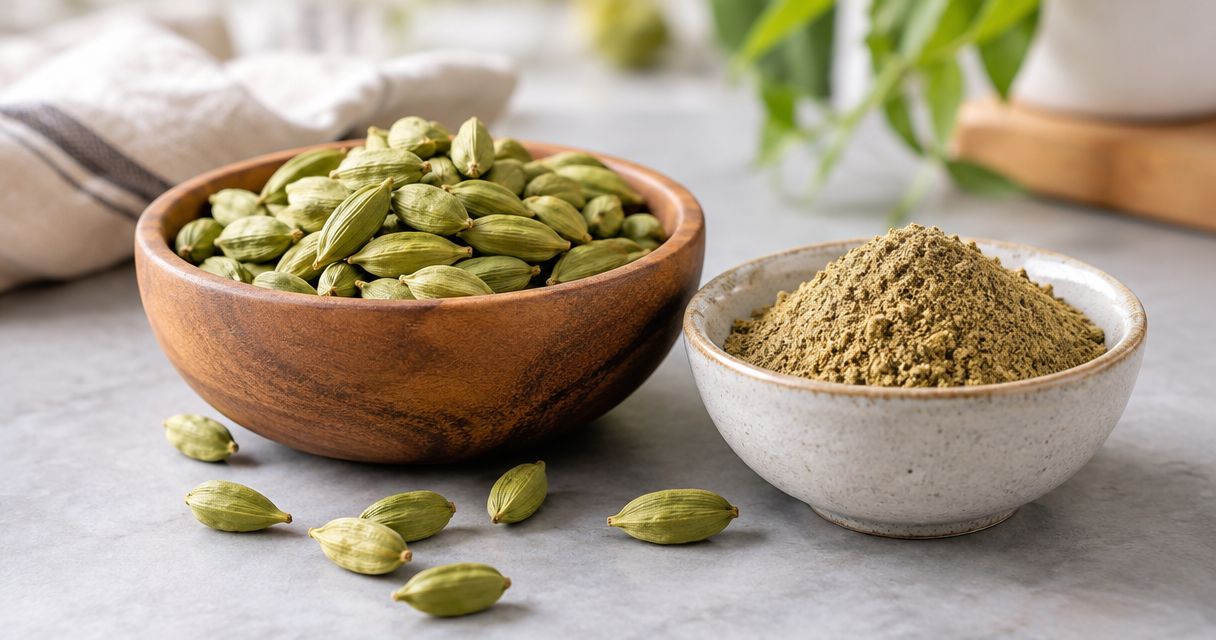
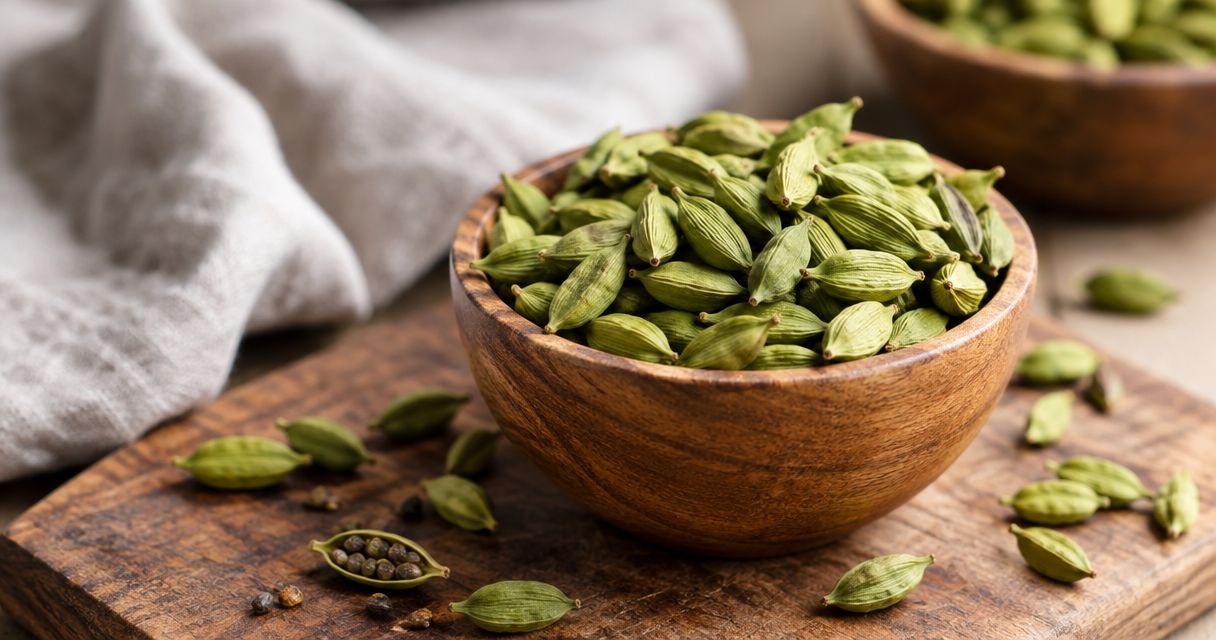
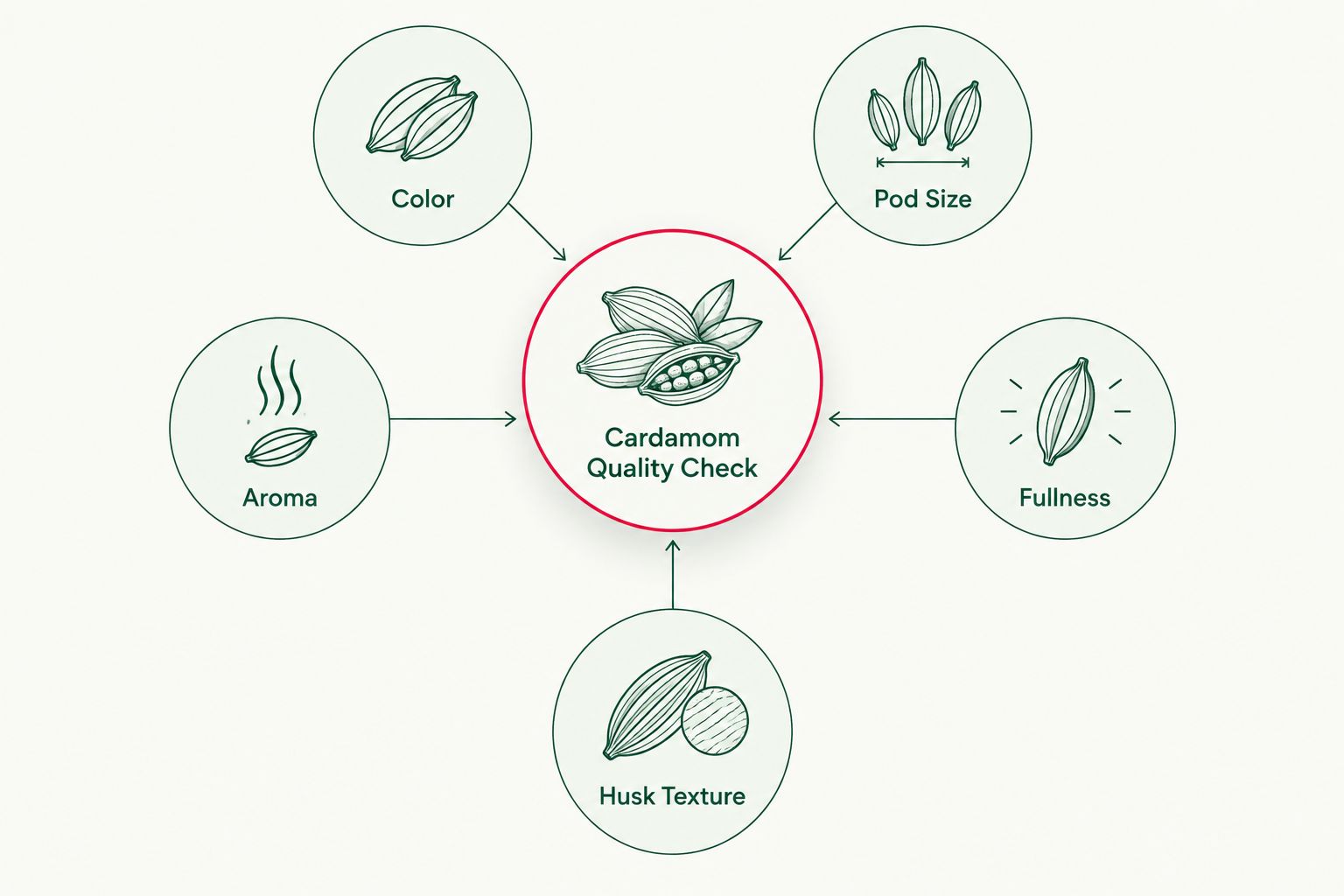
Good quality green cardamom shows five signs before you even open the jar: bright olive-green pods, a size of 8 mm or larger, a strong sweet-camphor smell when you crush one, tight full bodies with seeds that rattle softly (not loose and hollow), and husks that are never yellow, brown, or artificially bleached white. Skip these checks and you risk buying undersized "mixed grade" pods, old stock that has lost most of its oil, or cardamom steam-treated to fake a fresher color.
- Good quality green cardamom is 8 mm+, bright green, full-bodied, and smells strongly of camphor-sweet oil when crushed.
- Bleached, yellow, or brown husks signal old stock or chemical treatment, not premium grade.
- Muzri sources single-origin Kerala cardamom directly, so grade and harvest region are known, not blended.
- Cafés and hotels buying in bulk should check pod fullness and aroma per batch, not just the size label on the bag.
Why this matters
Most green cardamom sold loose or in unlabeled packets in Indian markets is a blend of grades and harvests, so the pod in your hand tells you more than the label does. Organic green cardamom sourced single-origin from one Kerala estate carries a traceable harvest date and grade, which matters if you're paying a premium for it.
For home cooks the stakes are aroma in biryani, chai, and payasam. For chefs and café buyers, the stakes are consistency across every batch and margin protected against paying bold-grade prices for mixed-grade pods. Both groups are checking the same five things, just at different volumes.
How to identify good quality green cardamom
Run this comparison before you buy, whether you're picking up a 50 g pack or a 5 kg bulk order.
| Indicator | Good quality | Poor quality |
|---|---|---|
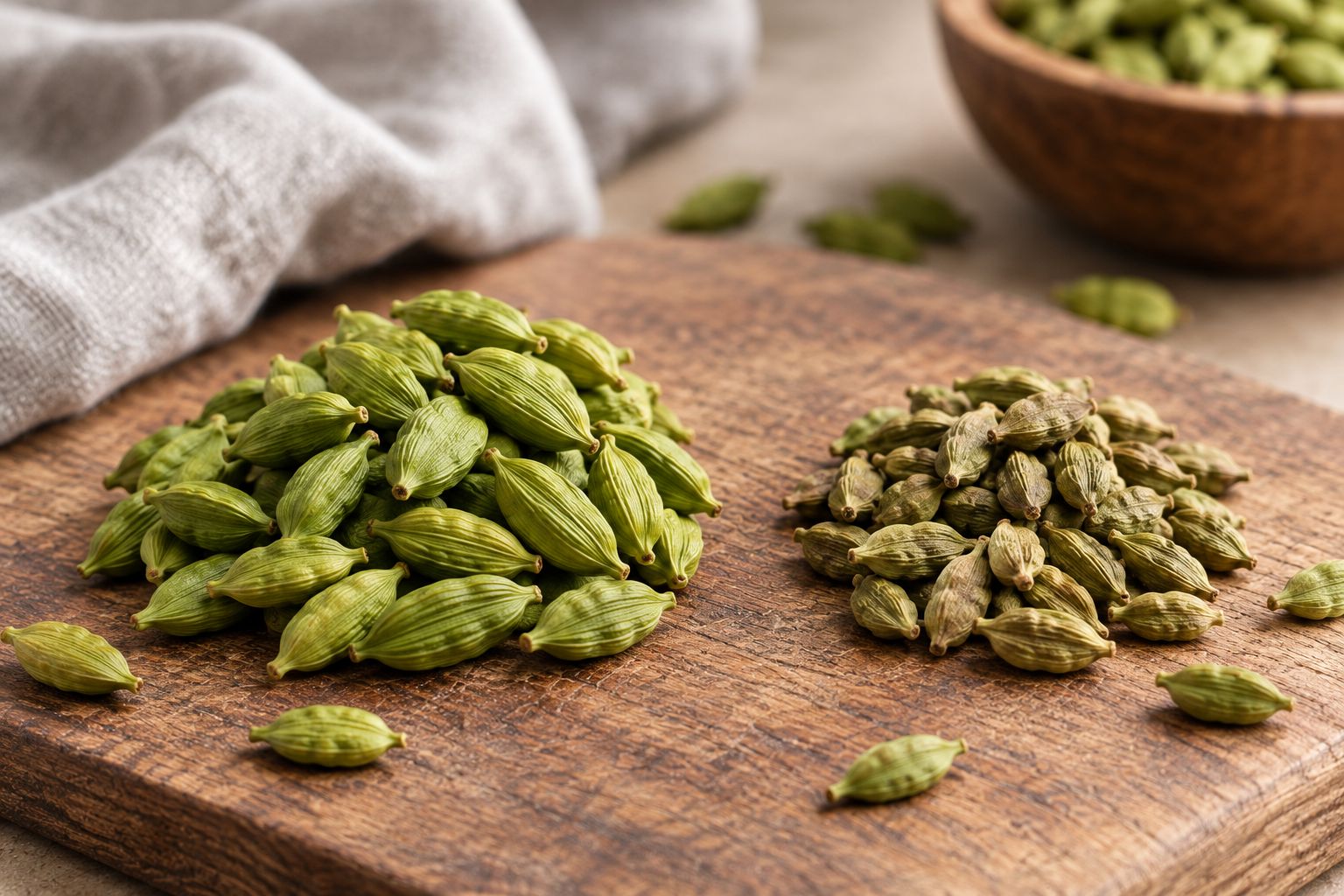
| Color | Bright olive to deep green, uniform | Yellow, brown, or patchy fading |
| Size | 8 mm and above, consistent pod size | Mixed sizes, many under 7 mm |
| Pod body | Full, plump, seeds rattle gently when shaken | Empty, shriveled, or seeds rattle loudly (dried out) |
| Aroma | Strong sweet-camphor scent released when crushed | Faint, musty, or almost no smell |
| Husk texture | Smooth, slightly ridged, dry but not brittle | Cracked open, powdery residue, sticky, or unnaturally white |
| Impurities | Clean, free of dust, stems, or broken pods | Visible dust, husk fragments, or stem bits mixed in |
The crush test is the fastest single check. Break one pod between your fingers, roll the seeds slightly, and smell immediately. Fresh, well-cured green cardamom releases a sharp, sweet, slightly minty-camphor note almost instantly, driven by volatile compounds like 1,8-cineole that fade steadily as the pod ages or dries out further after harvest. If you have to hold the pod to your nose and wait, it's past its best.
8 mm and above (Bold grade): buy this for aroma-first cooking
Bold-grade pods, 8 mm or larger, carry the most seed volume per pod and the strongest oil concentration, which is why they command the highest price in Kerala's cardamom auctions. Use this grade for chai, kheer, biryani, and any dish where cardamom is the dominant flavor note, not a background spice.
Verdict: Buy for home cooking where aroma carries the dish and for gifting, where visible pod size signals quality.
7 mm to 7.5 mm (Standard grade): fine for everyday cooking, not for showcase dishes
Standard-grade pods still carry decent oil content but noticeably less than Bold. They work in dals, spice mixes, and masala blends where cardamom is one of six or seven ingredients and its exact strength matters less.
Verdict: Hold as a budget option for daily cooking, but don't pay Bold-grade prices for this size.
Below 7 mm or broken pods (Mixed/Small grade): skip for anything you're paying a premium for
This is the grade most likely to show up unlabeled in loose bazaar cardamom or cheap "assorted" packets. Oil content is inconsistent pod to pod, and a chunk of the volume is often broken husk with no seeds inside.
Verdict: Skip unless the price reflects it clearly and you're using it for bulk decoction or extract work where pod size doesn't matter.
Why cardamom quality varies
Quality isn't random. A handful of factors, from farm to shelf, decide whether a pod ends up Bold-grade fresh or Mixed-grade stale.
- Harvest timing: Pods picked slightly immature dry lighter and lose aroma faster than pods harvested at full maturity.
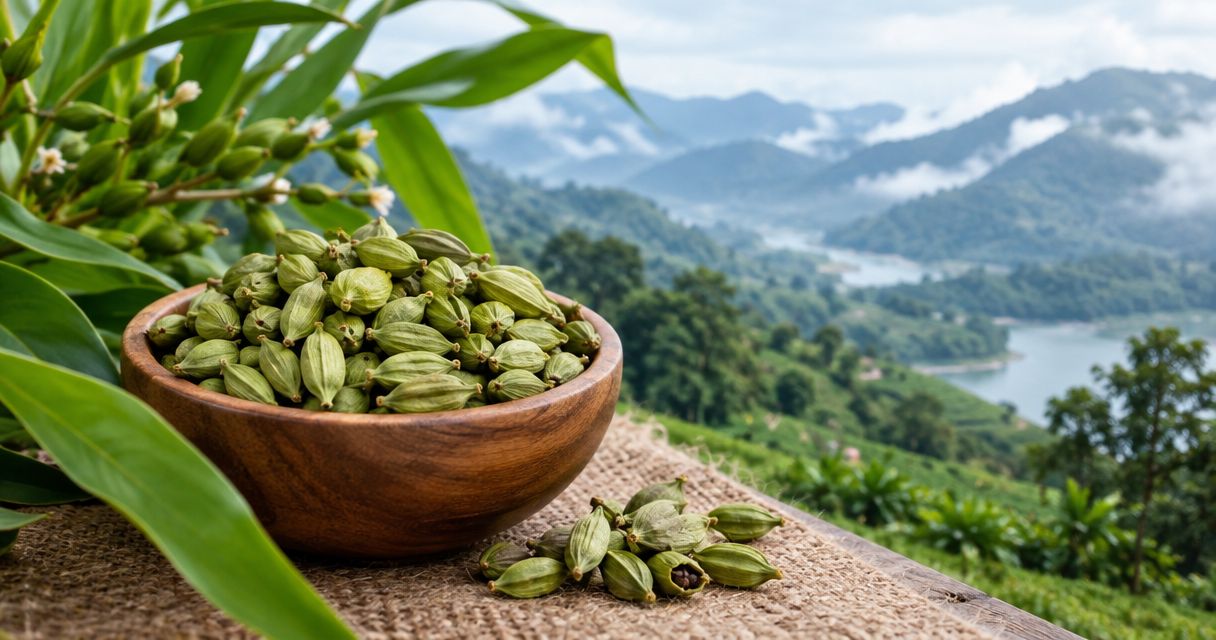
- Growing altitude and region: Cardamom grown in Kerala's high-altitude tracts like Idukki tends to develop denser oil content than lowland cultivation, a distinction the Spice Coast has been known for.
- Drying method: Sun-dried and slow kiln-dried pods retain more volatile oil than pods flash-dried at high heat to cut processing time.
- Storage conditions after drying: Heat, humidity, and light exposure during storage strip aroma out of even a well-graded pod within months.
- Age of stock: Cardamom doesn't have an indefinite shelf life once dried; aroma peaks in the months after harvest and declines steadily after that.
- Processing additives: Some traders bleach or sulfur-treat pods to even out color for retail display, which masks age but doesn't restore lost oil.
Bulk buyers feel these factors most directly, because a café or hotel kitchen is reordering the same grade every month and any drop in aroma shows up in customer-facing dishes. The green cardamom buying guide for cafés covers how to standardize a reorder spec around these variables instead of just a size number.
Shop organic green cardamom
Single-origin Kerala cardamom, graded by pod size and checked for aroma before dispatch.
Is bigger cardamom always better quality?
Bigger pods, 8 mm and above, generally carry more seed volume and higher oil content, but size alone doesn't guarantee freshness. A large pod that's been sitting in storage for over a year in 2026 can smell weaker than a smaller pod from a recent harvest, so always pair the size check with the crush-and-smell test.
How can you tell if cardamom is fresh or old?
Fresh cardamom releases a sharp, sweet-camphor smell the instant you crush it and feels slightly springy, not brittle, between your fingers. Old cardamom smells faint or musty, feels dry and brittle, and often has seeds that rattle loosely inside a shrunken husk. If a batch bought in early 2026 already smells weak, it was likely old stock at the point of sale, not spoiled after purchase.
Does color indicate cardamom quality?
Color is a useful first filter but not a complete answer on its own. Bright, uniform olive-green usually points to good curing and recent harvest, while yellow, brown, or unnaturally bright white pods point to age, poor drying, or bleaching, so treat color as step one and the crush test as confirmation.
FAQ
What is the best size for good quality green cardamom?
8 mm and above, known as Bold grade, is the best size for good quality green cardamom because it carries the most seed volume and oil content per pod. Smaller grades under 7 mm work fine for everyday cooking but carry less aroma.
How much does good quality green cardamom cost compared to mixed grade?
Bold-grade (8 mm+) cardamom sells at a premium over mixed or small-grade pods because of its higher oil content and larger seed volume. Exact pricing varies by seller and season, so check current listings rather than relying on a fixed figure.
Is green cardamom from Kerala better than other regions?
Kerala's high-altitude tracts, particularly around Idukki, have grown cardamom for centuries and are associated with dense oil content and strong aroma. Single-origin sourcing from a known Kerala estate also makes grade and harvest date traceable, unlike anonymous blended stock.
How do I check cardamom quality before buying online?
Look for the stated pod size (8 mm+ is Bold grade), a recent harvest or packing date, and a description of single-origin sourcing rather than a generic blend. Reviews mentioning aroma on arrival are a useful secondary check since you can't crush-test a pod before ordering online.
Does organic certification affect green cardamom quality?
Organic certification confirms the farming method, not pod size or aroma directly, though pods grown without synthetic inputs are less likely to carry bleaching or chemical residue used to mask age. Check the certification alongside grade and harvest date, not as a substitute for them.
Can bleached or white cardamom still be good quality?
No, bleached or unnaturally white cardamom pods usually signal chemical treatment used to even out color on aged stock, not a mark of quality. Genuine good quality green cardamom stays a natural olive-green shade without artificial whitening.
How should cafés and hotels buy green cardamom in bulk?
Cafés and hotels should standardize on one grade (8 mm+ for showcase dishes, 7 mm for daily cooking) and reorder from the same single-origin source to keep aroma consistent batch to batch. Checking a sample pod on arrival for the crush-and-smell test catches quality drift before it reaches the kitchen.
One last thing
The crush-and-smell test beats every visual check combined, because color and size can be managed by a trader but oil content can't be faked past a few seconds of smell. Keep a jar you know is genuinely fresh Bold-grade cardamom as your reference point, and test every new batch against it before you commit to a bulk order in 2026.