Organic cardamom certification is worth checking before you buy in 2026, but the certification itself is only proof of pesticide-free growing — not proof of freshness, aroma, or grade. A pack showing a real NPOP or India Organic certificate number is worth paying for; a pack that just says "organic" on the label with no certifying body named is a claim you can't verify.
- Organic cardamom certification (NPOP, India Organic, PGS-India) verifies pesticide-free cultivation, not freshness or aroma.
- A real certificate carries a specific batch or lot number — a logo image alone proves nothing.
- FSSAI's Organic Foods Regulations have required NPOP or PGS-India certification on any product labeled 'organic' in India since 2018.
- Muzri's green cardamom is sourced single-origin from Kerala farms, with grade and origin stated per batch rather than as a blended lot.
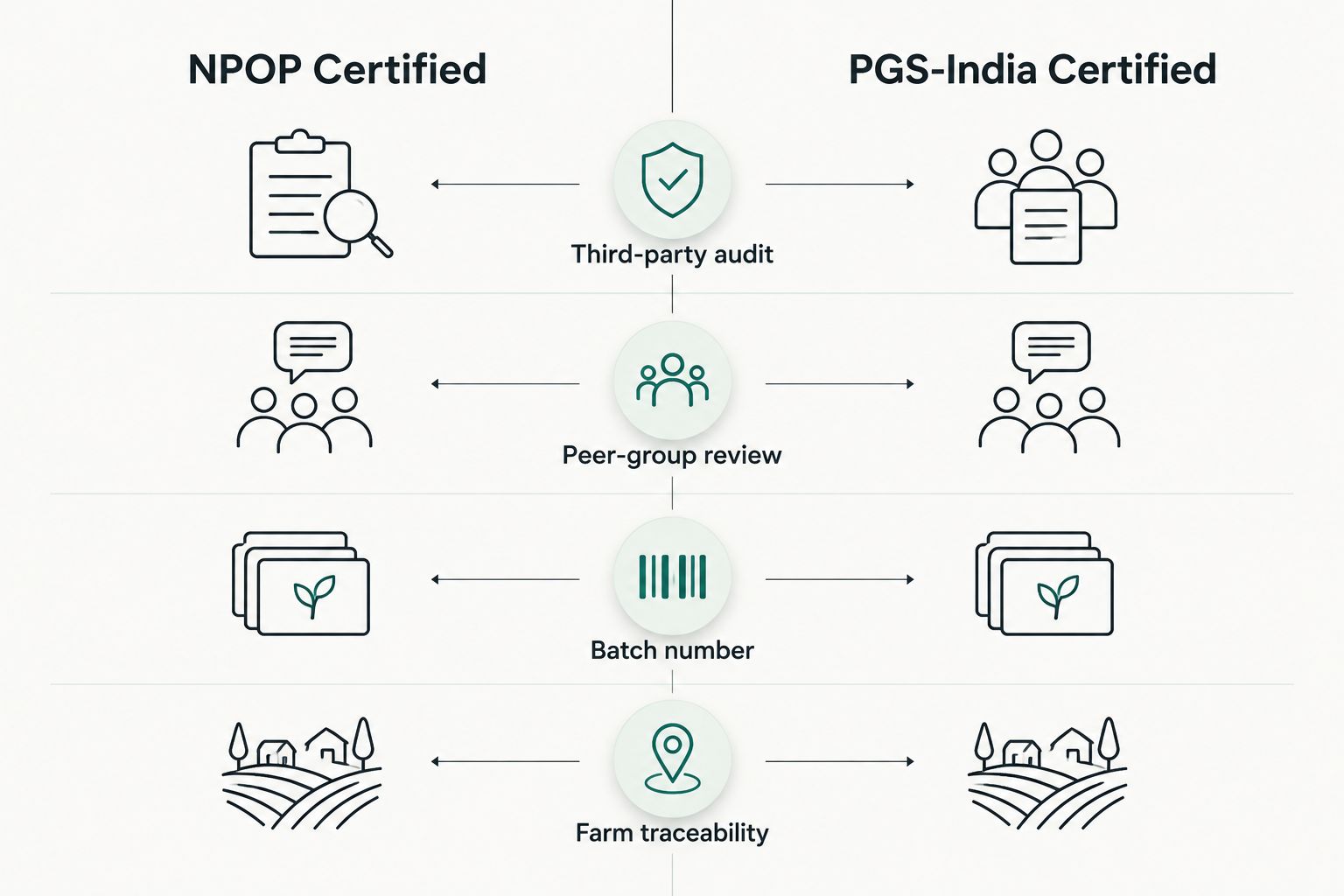
- PGS-India certification is common among small Kerala growers and is legitimate under FSSAI rules, but it carries less third-party audit than NPOP.
Why this matters
Organic labeling on spices has grown loosely policed for years, and cardamom is one of the most mislabeled categories in Indian retail because of how easily lower grades get repacked under premium claims. FSSAI's Organic Foods Regulations, in force since 2018, require any product sold as "organic" in India to carry either NPOP or PGS-India certification — most small spice sellers still skip this.
That gap matters more in 2026 as organic food demand keeps rising and more sellers slap the word on packaging without the paperwork behind it. If you're buying cardamom for a café, hotel kitchen, or your own pantry, the certificate is the only thing standing between an actual pesticide-free claim and marketing copy.
Is organic cardamom worth it in 2026?
It depends entirely on what backs the claim on the pack. The table below breaks down the four categories you'll actually run into when shopping.
| Type | Proof offered | Traceability | Best for |
|---|---|---|---|
| NPOP / India Organic certified | Certificate with a specific number, third-party audited annually | Single farm or farmer group named | Buyers who want a verifiable pesticide-free claim. Buy. |
| PGS-India certified | Peer-reviewed by a registered farmer group, government-recorded | Regional group traceability, lighter third-party audit | Small-farm buyers comfortable with peer-review certification. Buy. |
| "Organic" claim, no certificate named | Seller's word only, no verifiable document | Usually a blended lot, origin unclear | Anyone who cares about traceability. Skip. |
| Conventional, no organic claim | None — sold as regular grade | Market-lot traceability only | Buyers prioritizing grade and price over the organic claim. Hold, if grade and freshness check out. |
See how the major Kerala sellers stack up on certification and grade in the best organic cardamom brands in India comparison.
What NPOP and India Organic certification actually verify
NPOP (National Programme for Organic Production) certification is issued after a third-party body audits the farm's soil, inputs, and processing chain, then re-audits annually to keep the certificate valid. The certificate carries a registration number tied to the certifying agency, and the pack should show that number, not just a green "organic" logo.
This is the certification level export-facing sellers use, since it's the one recognized in most international organic trade frameworks. For a home cook or café buyer in India, the practical value is the same: it means someone outside the seller actually checked the farm.
PGS-India: the small-farm alternative
PGS-India (Participatory Guarantee System) is a peer-review certification registered with the National Centre of Organic Farming, built for small and marginal farmers who can't absorb the cost and paperwork of third-party NPOP audits. A local group of farmers reviews and vouches for each other's practices instead of an outside auditor doing it alone.
It's fully legitimate under FSSAI's 2018 rules — a PGS-India tag is not a lesser claim, just a different audit model. Many smaller Kerala cardamom growers carry PGS-India rather than NPOP for exactly this reason. Cafés and hotels sourcing in volume should still check grade specifications separately; the green cardamom buying guide for cafés covers what grade to specify for high-volume kitchen use.
Why organic certification credibility varies
- Certifying body: third-party NPOP audit versus peer-reviewed PGS-India versus no certification at all
- Traceability: a named single farm or farmer group versus an anonymous blended lot
- Certificate specificity: a batch or lot number you can check versus a reused generic logo
- Audit frequency: annual re-certification versus a one-time claim made years ago
- Processing chain: organic status can lapse if the cardamom passes through an uncertified sorting or packing facility after harvest
- Grade stated alongside certification: an 8 mm bold pod size named on a certified pack tells you more than certification alone
Check certification before you order
Muzri's Kerala cardamom listings state grade and certification status per batch.
Does organic certification guarantee better aroma or freshness?
Organic certification guarantees pesticide-free cultivation, not aroma or freshness — those depend on harvest timing, drying method, and how recently the pack was sealed. A certified organic cardamom pod that's been sitting on a shelf for a year will smell weaker than a fresh conventional pod picked and dried within the last few months.
Is USDA Organic the same as India's NPOP certification?
USDA Organic and NPOP certification are separate systems run by different regulators, each with their own audit standards and documentation. A cardamom seller targeting Indian retail only needs NPOP or PGS-India certification under FSSAI rules; USDA Organic only matters if the product is being exported and labeled for the US market.
How do I verify an organic cardamom certificate is real?
Check for a specific certificate or batch number printed on the pack, not just a logo image, and match it against the certifying body's own records where that's available. FSSAI's newer Jaivik Bharat logo carries a QR code that links to the batch's certification details, which makes this check faster than it used to be.
FAQ
Is organic cardamom worth the extra cost in 2026?
It's worth it when the pack shows a real NPOP, India Organic, or PGS-India certificate with a batch number — that's the only verified pesticide-free claim. Without a certificate named, the 'organic' label is unverified marketing.
What does NPOP certification mean for cardamom?
NPOP certification means a third-party body has audited the farm's soil, inputs, and processing chain and re-audits it annually. The certificate carries a registration number that should appear on the pack.
Is PGS-India certification as trustworthy as NPOP?
PGS-India is a legitimate, government-registered certification under FSSAI rules, but it relies on peer review by a farmer group rather than an outside third-party auditor. It's common among small Kerala cardamom growers who can't absorb NPOP's audit costs.
Does organic cardamom taste different from conventional cardamom?
Organic certification alone doesn't determine taste or aroma — grade, harvest timing, and drying method do. An 8 mm bold organic pod that's fresh will out-perform a poorly dried conventional pod of the same grade, but certification isn't the variable driving that difference.
What is the FSSAI rule on labeling spices as organic?
Since 2018, FSSAI's Organic Foods Regulations require any product labeled 'organic' and sold in India to carry NPOP or PGS-India certification. Sellers who skip this and still use the word 'organic' are not compliant with the regulation.
How can I check if an organic certificate on a spice pack is genuine?
Look for a specific certificate or batch number, not just a green logo image, and check it against the certifying body's records where available. The Jaivik Bharat logo introduced by FSSAI includes a QR code linking to the batch's certification data.
Is single-origin cardamom the same as organic cardamom?
No — single-origin means the cardamom comes from one traceable farm or region, while organic means it's certified pesticide-free. A cardamom pack can be single-origin without being organic, or organic without disclosing a single origin; the two claims answer different questions.
One last thing
The logo on a cardamom pack proves nothing by itself — logos get copied and reused across seasons long after a certificate has lapsed. What actually matters is the batch-specific number or the QR code under FSSAI's Jaivik Bharat mark, because that ties the claim to one audited harvest lot instead of a general promise. Check that number before you check the price in 2026.