
Running out of green cardamom mid-shift, or getting three different grades in three straight orders, is not a supply problem — it's a process problem. Instead of calling a local wholesaler every time stock runs low, set up a standing spice procurement workflow with named grades, a fixed reorder cadence, and a receiving check, and your kitchen stops improvising every week.
- Automate spice procurement in a cloud kitchen by fixing grade specs, reorder triggers, and receiving checks, not by chasing lower prices weekly.
- Lock a named grade — 8 mm+ green cardamom, for example — so every batch matches your last order.
- Match reorder frequency to shelf life: whole pods hold aroma far longer than ground turmeric or pre-ground spice.
- A one-page spec sheet per spice cuts most quality disputes before they start.
- Muzri's organic, single-origin Kerala spices work for this model because origin and grade stay consistent order to order.
Why this matters
Cloud kitchens run on repeat orders, tight food cost margins, and staff who rotate fast. A kitchen sourcing turmeric or pepper on an ad-hoc basis from whichever vendor answers the phone that day ends up with batch-to-batch variance in colour, aroma, and moisture — and that variance shows up in customer complaints on delivery apps, not just in the kitchen.
A procurement workflow removes the daily decision. Once your grade spec, order cadence, and receiving check are set, ordering spice becomes a scheduled task instead of a fire drill. This matters more in 2026 than it did a few years back, simply because delivery-app kitchens now run tighter margins and can't absorb inconsistent input costs the way a dine-in restaurant can. Cafes and hotel kitchens buying green cardamom in bulk deal with the same consistency problem — the fix is the same workflow, scaled to volume.
Before you start
- Consumption data: at least four to six weeks of per-outlet spice usage, pulled from your POS or kitchen inventory sheet, broken down by spice and by kilogram.
- A named point of contact: one person per outlet (or a central commissary buyer) who owns the order, not whoever is free that shift.
- Storage capacity check: airtight, dry storage away from heat for whole pods and powders — spice quality degrades fast in a hot kitchen back room, and this is the gotcha that catches most kitchens mid-setup. You can lock a perfect grade spec and still lose aroma in three weeks if storage isn't planned before the first bulk order arrives.
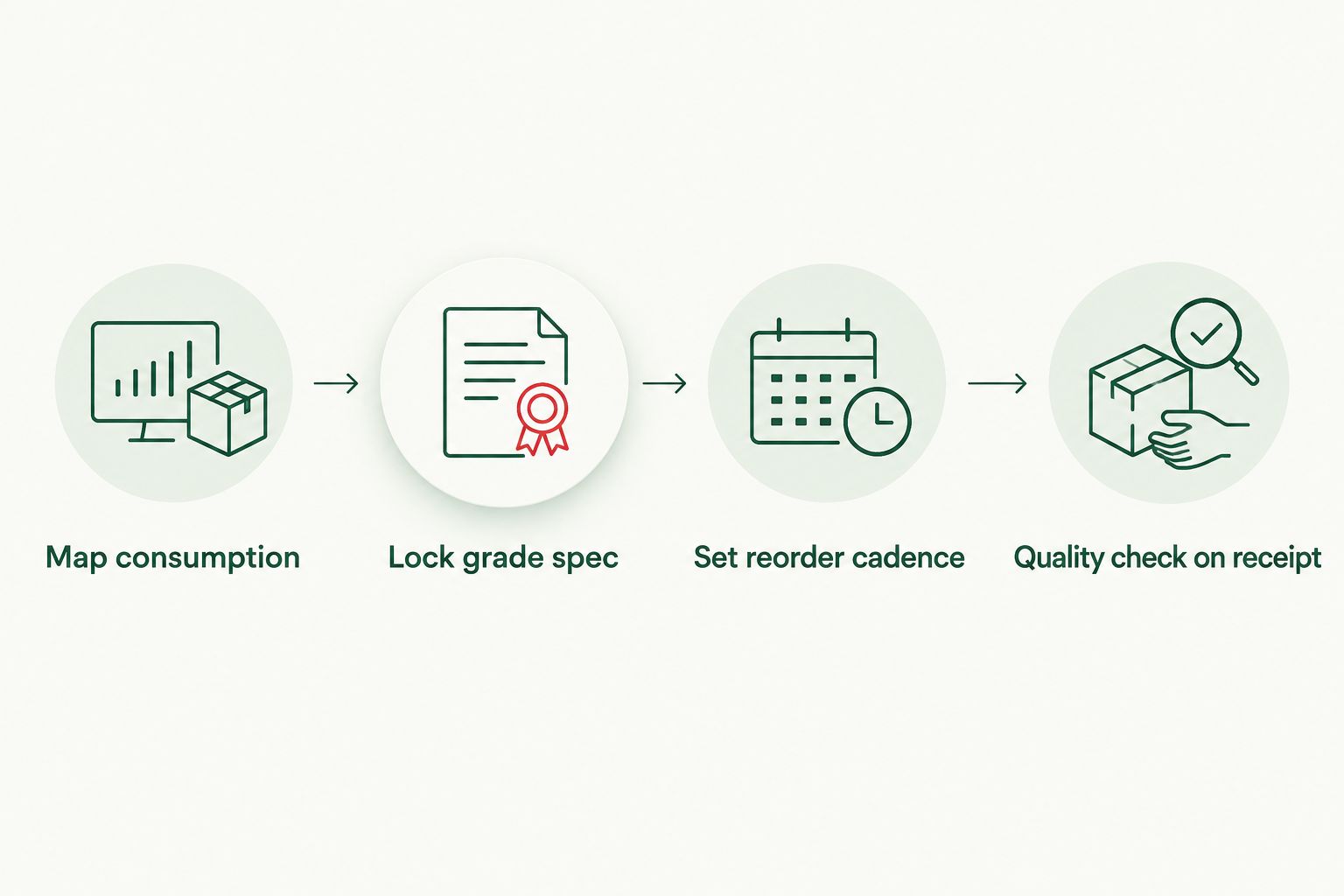
Map your monthly spice consumption
- Pull kilogram usage per spice, per outlet, from your POS or inventory log for the last four to six weeks.
- Convert that into a weekly par level — the stock quantity that should never be crossed before reordering.
- Flag seasonal spikes: biryani-heavy menus, festival periods, or new outlet launches push cardamom and pepper usage up fast, and your par level needs a buffer for that.
Expected result: a one-page consumption sheet per outlet showing weekly par levels for each spice you buy in bulk.
Lock your grade and origin spec
- Pick a named grade for each spice — for cardamom, that means specifying pod size (8 mm+, for example) and origin, not just "green cardamom."
- Check what that grade actually means before you write it down. The difference between 8 mm and 7 mm cardamom is bigger than a millimetre — pod size affects aroma intensity and yield per kilogram, both of which matter at cloud kitchen volume.
- Write the spec — grade, origin, organic status, processing method — into a one-page sheet and attach it to every reorder, not just the first one.
Expected result: a spec sheet that lets any staff member place a reorder without guessing what "the usual" means.
Set your reorder cadence and quantity
- Match order frequency to shelf life, not to convenience. Whole pods hold aroma considerably longer than ground powder, so ordering cardamom pods less often and turmeric powder more often is the right split, not the reverse.
- Set a reorder trigger tied to your par level — when stock hits roughly two weeks of usage, the next order goes out, not when someone notices the tin is empty.
- Send the order through Muzri's bulk enquiry channel with your spec sheet attached so grade and quantity are confirmed in writing before dispatch.
Expected result: a recurring order rhythm with no last-minute local market runs before a weekend rush.
Build in a receiving quality check
- Check pod size and colour against your spec sheet the moment a batch arrives — bold, deep-green pods versus pale or split ones is a visible difference, not a subjective one.
- Open a sample and smell-test it. Aroma should be noticeable immediately on opening; log anything muted or musty before the batch reaches the line.
- Weigh the batch against the invoice, log the receiving date, and sign off before it goes into storage.
Expected result: any inconsistency is caught at the door, not discovered mid-service when a dish tastes off.

Running this across multiple outlets
A single cloud kitchen brand with three or four outlets faces a choice: let each outlet order independently, or centralize procurement through one commissary buyer. Centralizing wins on consistency — one spec sheet, one reorder cadence, one vendor relationship — but it needs a shared consumption tracker so no single outlet runs dry while another is overstocked. If outlets are geographically spread, split the cadence: order more frequently in smaller quantities per outlet rather than one giant batch that sits in transit longer than it should.
Set up your bulk spice order
Browse organic, single-origin Kerala spices for kitchen-scale ordering.
Troubleshooting
- Batch arrives at a lower grade than specified: escalate immediately against your written spec sheet — this is exactly why the spec exists, and a written record makes the correction fast rather than a back-and-forth argument.
- Aroma fades before the batch is used up: almost always a storage issue, not a vendor issue. Heat and humidity near a kitchen line strip aroma from whole pods within weeks.
- Reorder price jumps between cycles: cardamom pricing tracks harvest and auction cycles, especially for Idukki-region stock, so budget with a price benchmark by grade rather than assuming last month's rate holds.
- Outlets order inconsistent volumes month to month: a sign the consumption tracker isn't being updated — fix the tracker before fixing the order size.
- Delivery delays during monsoon months: build a one-week buffer into your par level from June through September; transit times lengthen in that window across most of India.
Muzri's organic, single-origin Kerala spices work for this workflow because the origin and grade don't shift order to order — that consistency is the entire point of automating procurement in the first place.
Customize your workflow
Once the core loop is running, expand it. Add a second spec sheet for black pepper alongside cardamom, using the same grade-lock-and-check model. Kitchens buying at hotel or multi-outlet volume can lean on a dedicated wholesale conversation rather than the standard online cart — reach out to Muzri's bulk team directly to set that up once your consumption numbers are ready. If you're still deciding which grade to standardize on, work through the practical checks in how to identify good-quality green cardomom before you lock your spec sheet.
FAQ
How do I automate spice procurement for a cloud kitchen?
Set a fixed grade spec, a reorder trigger tied to your weekly par level, and a receiving quality check for every batch. Once those three pieces are in place, ordering becomes a scheduled task instead of a daily decision.
What's the best cardamom grade for a cloud kitchen or cafe?
8 mm+ green cardamom is the standard bulk-buying benchmark for aroma and yield. Smaller grades cost less per kilogram but need more pods per dish, which often erases the savings.
How often should a cloud kitchen reorder spices?
Match cadence to shelf life: whole cardamom and pepper pods can be ordered every few weeks, while ground turmeric and other powders should be reordered more often since they lose aroma faster once opened.
Should I buy spices in bulk from one vendor or split across multiple?
One vendor with a locked grade spec gives consistent batches, which matters more for food cost control than chasing marginal price differences across multiple sellers.
How do I check if a spice batch matches what I ordered?
Check pod size and colour against your written spec sheet, then run a quick smell test on opening. Aroma should be immediately noticeable; anything muted signals an old or lower-grade batch.
Does organic certification matter for kitchen-scale spice buying?
It matters for traceability and consistency of processing method, both of which reduce batch-to-batch variance — the same variance that a procurement workflow is built to eliminate.
What's the biggest mistake cloud kitchens make when buying spices in bulk?
Ordering without a written grade spec. Without one, every batch is judged by memory, and disputes over quality become impossible to resolve quickly.
One last thing
The kitchens that get the most out of this workflow are the ones that write the spec sheet down on day one, not after the third inconsistent batch. A verbal understanding of "the good cardamom" falls apart the moment a new staff member takes the order call — a one-page sheet doesn't.