Best overall in 2026: Batch-Tested Whole Black Pepper with a current certificate of analysis. Best for traceable Kerala origin: Muzri Malabar Black Pepper. Best for pepper mills: TGSEB-grade pepper. Best for convenience: pre-ground black pepper.
- A current batch certificate is the best evidence for black pepper pungency and oil content in 2026.
- Muzri Malabar Black Pepper suits buyers prioritising organic, single-origin Kerala sourcing.
- TGSEB identifies bold berry size; it does not prove piperine or volatile oil levels.
- Whole pepper retains aroma better than pre-ground pepper after opening.
Why this matters
Piperine and volatile oil measure different parts of pepper quality. Piperine is the non-volatile compound responsible for pungency, while volatile oil carries much of the aroma released when a peppercorn is cracked or ground. Strong heat does not automatically mean strong aroma, and an aromatic pepper can still have moderate pungency.
Codex Standard CXS 326-2017 provides useful baselines for whole black pepper: at least 2% piperine, at least 2 ml/100 g of volatile oil and no more than 13% moisture. These are minimum requirements, not proof that one origin or brand tastes better than another. A serious 2026 comparison needs results from the current batch rather than an unsupported claim based on origin alone.
Berry size, origin and organic status can help you narrow the field, but none replaces laboratory data. A seller claiming unusually high black pepper pungency and oil content should be able to identify the lot tested, the test date, the laboratory and the methods used.
What makes the best black pepper
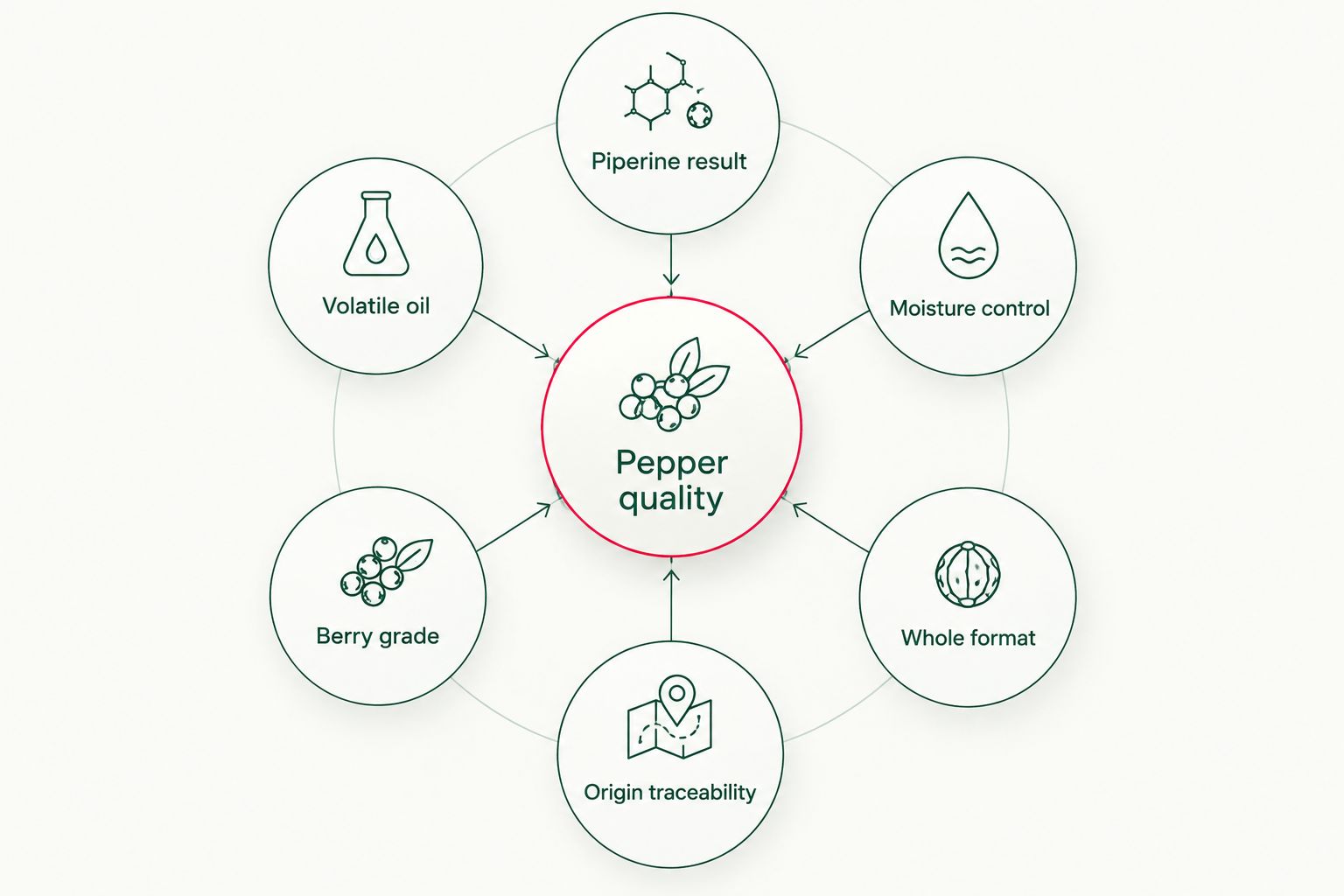
The strongest buying decision in 2026 combines chemistry, physical quality and traceability:
- Piperine result: Look for a batch-specific percentage. Higher piperine generally produces a stronger bite, but the number must relate to the lot being sold.
- Volatile oil result: This should be reported in a recognised unit such as ml/100 g. It describes aromatic oil, not cooking oil added to the product.
- Moisture control: Excess moisture affects storage stability. The Codex maximum of 13% is a useful baseline for whole black pepper.
- Berry grade: Size grades such as TGSEB help predict physical uniformity. They do not establish piperine or volatile oil content.
- Whole or ground format: Whole pepper exposes less internal surface area before grinding, helping preserve aroma during storage.
- Origin traceability: A named region or single-origin claim makes a lot easier to trace, but origin still needs batch evidence when chemistry is the deciding factor.
Black pepper at a glance
| Rank | Black pepper option | Best for | Standout feature | Key limitation |
|---|---|---|---|---|
| 1 | Batch-Tested Whole Black Pepper | Verified pungency and aroma | Current piperine and volatile-oil results | Quality remains specific to the tested batch |
| 2 | Muzri Malabar Black Pepper | Organic, single-origin Kerala sourcing | Clear product origin | Origin alone does not quantify piperine or oil |
| 3 | TGSEB Black Pepper | Pepper mills and bold berries | Large berry-size grade | Size is not a chemical quality result |
| 4 | Malabar Garbled Black Pepper | Uniform everyday whole pepper | Cleaned and sorted trade format | Garbled is not a pungency grade |
| 5 | Wayanad Single-Origin Black Pepper | District-level provenance | Specific Kerala origin | Regional name does not guarantee potency |
| 6 | Pre-Ground Black Pepper | Immediate convenience | No grinder required | Aroma declines faster after grinding |
1. Batch-Tested Whole Black Pepper: best for verified potency
Batch-Tested Whole Black Pepper ranks first because it answers the actual query with evidence. The certificate of analysis should identify the lot and report both piperine and volatile oil; a generic specification sheet only states what a supplier intends to provide.
A complete document should also show moisture because a chemically strong sample still needs suitable storage quality. Compare the reported results with the Codex baselines, then confirm that the certificate applies to the stock you will receive in 2026.
Batch-Tested Whole Black Pepper pros:
- Provides measurable piperine and volatile-oil results
- Connects quality claims to an identifiable batch
- Supports repeatable specifications for chefs, cafés and hotels
- Makes comparisons between suppliers more objective
Batch-Tested Whole Black Pepper cons:
- One certificate does not establish the quality of future batches
- A report without a lot number cannot reliably identify the supplied pepper
- Laboratory results do not fully predict whether you will prefer the aroma
Best for: professional buyers and home cooks who want evidence rather than origin-based assumptions.
Verdict: Buy when the certificate matches the supplied lot.
2. Muzri Malabar Black Pepper: best for traceable Kerala origin
Muzri Malabar Black Pepper is the strongest fit for Indian buyers prioritising organic, single-origin Kerala sourcing. The range serves home cooks, chefs, cafés and hotels across India, making this a provenance-led choice rather than an anonymous blended-origin option.
Organic status and Kerala origin do not reveal piperine, volatile oil, moisture or berry size. Buyers sourcing against a technical specification should request current batch data instead of treating the Malabar name as a substitute for measurement.
Muzri Malabar Black Pepper pros:
- Organic black pepper from Kerala
- Single-origin positioning gives buyers a specific sourcing region
- Relevant to small online orders and professional kitchen requirements
- Malabar origin is directly connected to the product description
Muzri Malabar Black Pepper cons:
- No batch piperine result is available in the supplied product information
- No batch volatile-oil result is available in the supplied product information
- Berry size and named trade grade are not specified
Best for: Indian buyers who place organic, single-origin Kerala sourcing ahead of laboratory-led comparison.
Verdict: Buy for documented origin; require a current certificate when chemistry determines acceptance.
3. TGSEB Black Pepper: best for pepper mills
Tellicherry Garbled Special Extra Bold, usually shortened to TGSEB, is a physical size grade associated with large pepper berries. Trade specifications commonly connect the grade with berries retained on a 4.75 mm sieve, although buyers should confirm the seller's exact specification before ordering.
Large, consistent berries feed pepper mills more evenly and give chefs a visually uniform whole spice. TGSEB does not automatically contain more piperine or volatile oil than a smaller grade, so a bold appearance cannot settle a chemistry-based ranking.
TGSEB Black Pepper pros:
- Recognisable bold-berry trade grade
- Consistent physical format for table and kitchen pepper mills
- Easy to assess visually for size uniformity
TGSEB Black Pepper cons:
- Berry diameter does not prove pungency
- The grade name does not disclose volatile-oil content
- Supplier definitions should be checked against a sieve specification
Best for: restaurants and home cooks who value large, uniform peppercorns for fresh grinding.
Verdict: Buy for berry size, not as proof of stronger pungency.
4. Malabar Garbled Black Pepper: best for everyday whole-spice use
Garbled black pepper has been cleaned and sorted to remove unwanted material and improve physical consistency. Malabar garbled pepper therefore describes processing and origin, not a guaranteed piperine or oil result.
This option makes sense when you want whole Kerala pepper for routine grinding but do not need the largest TGSEB berries. Ask for the actual grade, crop or packing details and batch certificate when comparing commercial offers in 2026.
Malabar Garbled Black Pepper pros:
- Cleaned and sorted whole-pepper format
- Malabar origin gives the buyer a defined geographic reference
- Suitable for grinding as needed in daily cooking
Malabar Garbled Black Pepper cons:
- Garbling does not measure aroma or pungency
- Physical cleanliness cannot replace a chemical analysis
- Quality can differ between batches carrying the same trade description
Best for: everyday cooks who want sorted whole Malabar pepper without making berry size the priority.
Verdict: Buy when the lot is clean, aromatic and supported by suitable batch details.
5. Wayanad Single-Origin Black Pepper: best for district-level provenance
Wayanad is a pepper-growing district in Kerala, so its name gives buyers a more specific origin than a broad country label. Single-origin Wayanad pepper suits buyers who want to connect a spice to one region rather than an unspecified multi-origin blend.
The district name is not a formal pungency grade. Two Wayanad lots can differ because crop conditions, maturity, drying, storage and time since processing all affect the final spice.
Wayanad Single-Origin Black Pepper pros:
- District-level Kerala provenance
- Single-origin sourcing improves lot traceability
- Useful for menus or purchasing policies built around regional ingredients
Wayanad Single-Origin Black Pepper cons:
- The Wayanad name does not provide a piperine percentage
- Origin does not guarantee a volatile-oil result
- Buyers still need lot-specific evidence for technical procurement
Best for: chefs and home cooks who prioritise a clearly named Kerala growing region.
Verdict: Hold until origin and batch documents match the seller's claim.
6. Pre-Ground Black Pepper: best for immediate convenience
Pre-ground black pepper removes the grinding step and distributes quickly through marinades, batters and spice mixes. Its weakness is aroma retention: grinding exposes much more surface area to air, allowing volatile compounds to dissipate more readily during storage.
Judge it by the grind or packing date, aroma after opening and storage instructions rather than the origin name alone. Professional kitchens should also consider how quickly they consume an opened pack.
Pre-Ground Black Pepper pros:
- Ready to measure and mix
- Consistent particle size can simplify repeat recipes
- Practical where grinders are unavailable
Pre-Ground Black Pepper cons:
- Loses aromatic intensity faster than intact peppercorns
- You cannot inspect the original berry size or condition
- A stale ground sample cannot be restored by adding more of it
Best for: kitchens prioritising speed and uniform mixing over maximum aroma at the grinder.
Verdict: Skip for aroma-led dishes; buy only when convenience is the main requirement.
How this ranking was built
The 2026 ranking prioritises evidence in this order: current batch chemistry, traceable origin, physical grade, whole-pepper format and practical fit. It does not assign unsupported piperine or volatile-oil values to a country, region or brand.
For a bulk order, request a representative sample and certificate before approving the full lot. Check that the sample, document and delivered stock share the same lot identification. Home cooks can use a simpler version of the process: buy a modest quantity, inspect the whole berries, crack a few and assess whether the aroma remains clear after storage.
The same discipline applies to other Kerala spices. The green cardamom sourcing guide for hotels explains how grade, format and order requirements affect professional purchasing.
Shop single-origin Kerala spices
Browse organic Kerala spices for online orders across India.
Which black pepper should you choose?
Choose Batch-Tested Whole Black Pepper when pungency and volatile oil are contractual requirements. A current lot-specific certificate is the only defensible winner for black pepper pungency and oil content in 2026.
Choose Muzri Malabar Black Pepper when organic, single-origin Kerala sourcing is the priority. Choose TGSEB for bold, uniform berries in a pepper mill, Malabar Garbled for everyday whole-pepper use and Wayanad Single-Origin Black Pepper for district-level provenance. Pre-ground pepper belongs in kitchens where speed matters more than aroma retention.
FAQ
What determines black pepper pungency and oil content?
Piperine determines most of black pepper's pungency, while volatile oil carries much of its aroma. Variety, berry maturity, processing, storage and time since grinding can affect the final results.
What is the best black pepper in 2026?
Batch-Tested Whole Black Pepper with current piperine and volatile-oil results is the best evidence-led choice in 2026. A regional or grade name cannot prove chemical composition by itself.
Is Malabar black pepper more pungent than other pepper?
Malabar origin alone does not prove that a pepper lot is more pungent. Compare current piperine results from the relevant batches before making that claim.
Does TGSEB pepper contain more oil?
TGSEB does not automatically contain more volatile oil because TGSEB is primarily a bold berry-size grade. A laboratory result is needed to establish oil content.
How can I check black pepper quality without a laboratory?
Crack several peppercorns and assess their immediate aroma, berry consistency and visible cleanliness. This sensory check can identify weak or uneven stock, but it cannot provide a piperine percentage or volatile-oil value.
Is whole black pepper better than ground pepper?
Whole black pepper is better when aroma retention matters because less internal surface area is exposed before grinding. Pre-ground pepper is better only when convenience and rapid mixing take priority.
Does organic black pepper contain more piperine?
Organic status does not establish a higher piperine result. Organic describes production requirements, while piperine must be measured in the pepper itself.
What should hotels request when buying black pepper in bulk?
Hotels should request the grade, origin, lot identification and a current certificate covering piperine, volatile oil and moisture. The sample, certificate and delivered stock should refer to the same lot.
One last thing
Do not compare a supplier's maximum specification with another supplier's actual batch result. One is a possible ceiling; the other describes tested stock. In 2026, ask every shortlisted supplier for the same three fields — piperine, volatile oil and moisture — reported for the lot you can actually order.