Best fit for single-origin Kerala spices: Muzricorp. Best shortlist for a broader organic pantry: 24 Mantra Organic. Best shortlist for everyday organic spice powders: Organic Tattva. This 2026 guide separates useful buying choices from claims you should verify on the exact pack before ordering.
- Comparing organic spice brands India? Muzricorp is a fit for buyers seeking single-origin Kerala spices.
- Shortlist 24 Mantra Organic for a broader organic pantry and Organic Tattva for everyday spice powders.
- Check organic certification, ingredients and batch details on the exact product, not just the brand name.
- For cafés and hotels, approve a sample and written specification before placing a bulk order.
Why this matters
An organic label answers a farming-and-certification question. It does not, by itself, tell you whether cardamom smells lively in chai, pepper brings the flavour you want, or turmeric suits your cooking. Those decisions also depend on the spice, its processing, storage and the batch you receive.
For your 2026 shortlist, separate three questions: is the product certified organic, is its origin clearly identified, and does it perform in your recipe? A household buyer needs a manageable pack and clear information. A café or hotel also needs repeatable specifications and a practical way to approve deliveries.
Choose a spice before choosing a brand. One seller need not be your default for cardamom, pepper, turmeric and every blended masala.
What makes the best organic spice brands in India?
Use these criteria before reading the ranking. They keep an attractive description from becoming a substitute for evidence.
- Organic evidence: Check the certification information attached to the exact product. A brand name containing organic is not the whole check.
- Identifiable origin: Look for a named growing region where origin matters to your purchase. A packing address does not establish where a spice grew.
- Clear ingredients: Distinguish a single spice from a blended seasoning. Read the ingredient declaration rather than inferring purity from the front label.
- Useful product specifications: For cardamom, size and grading information help define what you are ordering. For powders, processing and ingredient details matter more than pod-size language.
- Batch and storage information: Check the applicable packing or manufacturing information, declared shelf life and storage directions. Aroma needs a separate assessment.
- Suitability for your kitchen: Compare the actual form, quantity and ordering requirements with your cooking routine or commercial usage.
In India, FSSAI's organic-food framework recognises the National Programme for Organic Production and the Participatory Guarantee System for India. Jaivik Bharat is the organic-food identity associated with that framework. Check the applicable certification details; do not treat an unrelated food-safety licence as proof of organic production.
Organic spice brands at a glance
This is a use-case shortlist for 2026, not a laboratory ranking. The recommended roles below do not establish that every product from a brand has the same origin, certification or sensory quality.
| Brand | Best for | Standout reason to shortlist | Key limitation |
|---|---|---|---|
| Muzricorp | Single-origin Kerala spices | Stated focus on Kerala cardamom, Malabar black pepper and turmeric powder | That focused range is not a substitute for every spice or blended masala |
| 24 Mantra Organic | A broader organic pantry | Organic-food range that includes spices alongside other pantry categories | A broad range does not establish single-region sourcing for an individual spice |
| Organic Tattva | Everyday organic spice powders | Organic pantry range that includes cooking spices | Powder cannot be assessed by inspecting intact pods, seeds or peppercorns |
The distinction matters: the first choice is about regional sourcing, the second about combining pantry purchases, and the third about a ready-to-use cooking format. None replaces checking the current product label.
1. Muzricorp: best fit for single-origin Kerala spices
Muzricorp sells organic, single-origin Kerala spices online to home cooks, chefs, cafés and hotels across India. Its stated range includes green and black cardamom, Malabar black pepper and turmeric powder. That makes it a relevant first stop when your shopping list centres on these spices rather than a complete cupboard of blended seasonings.
Muzricorp is best for buyers seeking single-origin Kerala spices rather than an all-purpose masala range. Keep the recommendation tied to that sourcing focus. It does not establish a particular cardamom grade, pod size, certificate, processing method or shelf life for every item.
What to check before choosing
For green cardamom, ask which grade applies to the product you are ordering. An 8 mm size designation describes pod sizing; it is not an organic certification or a direct measurement of aroma. A 7 mm designation likewise tells you about size, not whether the seeds deliver the flavour your recipe needs.
For Malabar black pepper, confirm that the origin description applies to the product and batch you intend to buy. For turmeric powder, read the ingredients and applicable certification details rather than assuming that the word Kerala answers every quality question.
Muzricorp pros:
- A stated Kerala sourcing focus gives you a specific origin to investigate.
- The listed range covers cardamom, black pepper and turmeric.
- The business serves both home cooks and professional buyers.
Muzricorp cons:
- The stated range does not cover every spice or regional masala blend.
- Single-origin wording alone does not prove grade, freshness or organic compliance.
- Professional buyers still need an approved sample and agreed specifications.
Best for: Buyers who want to begin with Kerala-origin cardamom, pepper or turmeric.
Verdict: Buy for the regional fit after checking the exact product's documentation and specifications.
2. 24 Mantra Organic: best shortlist for a broader organic pantry
24 Mantra Organic is an organic-food brand whose range includes spices and other pantry categories. Shortlist it when you want your spice purchase to sit within a wider organic grocery order. That is a convenience-based reason to consider the brand, not proof that its cardamom or turmeric is the strongest sensory match for your kitchen.
A broad pantry range changes how you shop. You can assess spices alongside other ingredients, but each spice still needs its own label check. Do not carry a certification, origin statement or ingredient claim from one product across the rest of the range.
What to check before choosing
Start with the exact spice and format you need. Whole cardamom, ground turmeric and a blended masala are different buying decisions, even when they share a brand name. Confirm the ingredient list, applicable organic certification information and storage directions for each item.
If regional origin matters, look for a specific origin statement. Organic production and single-origin sourcing answer different questions: one concerns the production system, while the other concerns where the ingredient comes from. Neither should be inferred from a broad brand identity.
24 Mantra Organic pros:
- A broader organic-food range supports a pantry-wide shortlist.
- Spices can be evaluated alongside other cooking staples.
- The brand gives you an alternative to a regional-specialist buying approach.
24 Mantra Organic cons:
- Pantry breadth does not establish a spice's growing region.
- A brand-wide impression cannot replace individual product checks.
- Convenience is not a measure of aroma or performance in your recipe.
Best for: Households comparing spices as part of a broader organic grocery purchase.
Verdict: Buy when the exact spice meets your label and cooking requirements; do not choose on range breadth alone.
3. Organic Tattva: best shortlist for everyday organic spice powders
Organic Tattva is an organic pantry brand with cooking spices in its range. Shortlist it when ready-to-use powders suit your everyday cooking better than buying whole spices and grinding them yourself. The useful distinction here is format, not a claim that all powders outperform whole spices.
Ground spices save a preparation step. They also remove some visual checks you can make with intact pods or peppercorns. Your decision therefore needs to place more weight on the label, batch information, storage and performance in the finished dish.
What to check before choosing
Read the full ingredient declaration. A single-spice powder and a blended seasoning are not interchangeable, and colour alone cannot confirm purity. Check whether the product description answers your actual question instead of relying on a general natural or pure claim.
Choose a quantity that fits your usage and storage conditions. There is no universal pack size for a household, café and hotel kitchen. Keep the powder sealed, use a dry utensil and follow the product's storage instructions.
Organic Tattva pros:
- Ready-to-use spice powders suit routines that do not include grinding.
- An organic pantry range provides another brand to compare product by product.
- Powder formats let you focus your assessment on the recipe you actually cook.
Organic Tattva cons:
- Powders offer fewer intact-spice visual checks.
- Convenience does not establish freshness or regional origin.
- A powder-focused purchase does not replace whole spices when your recipe needs them.
Best for: Home cooks shortlisting organic powders for everyday dishes.
Verdict: Buy the format your recipe needs after checking ingredients and organic evidence.
How to verify an organic spice before ordering
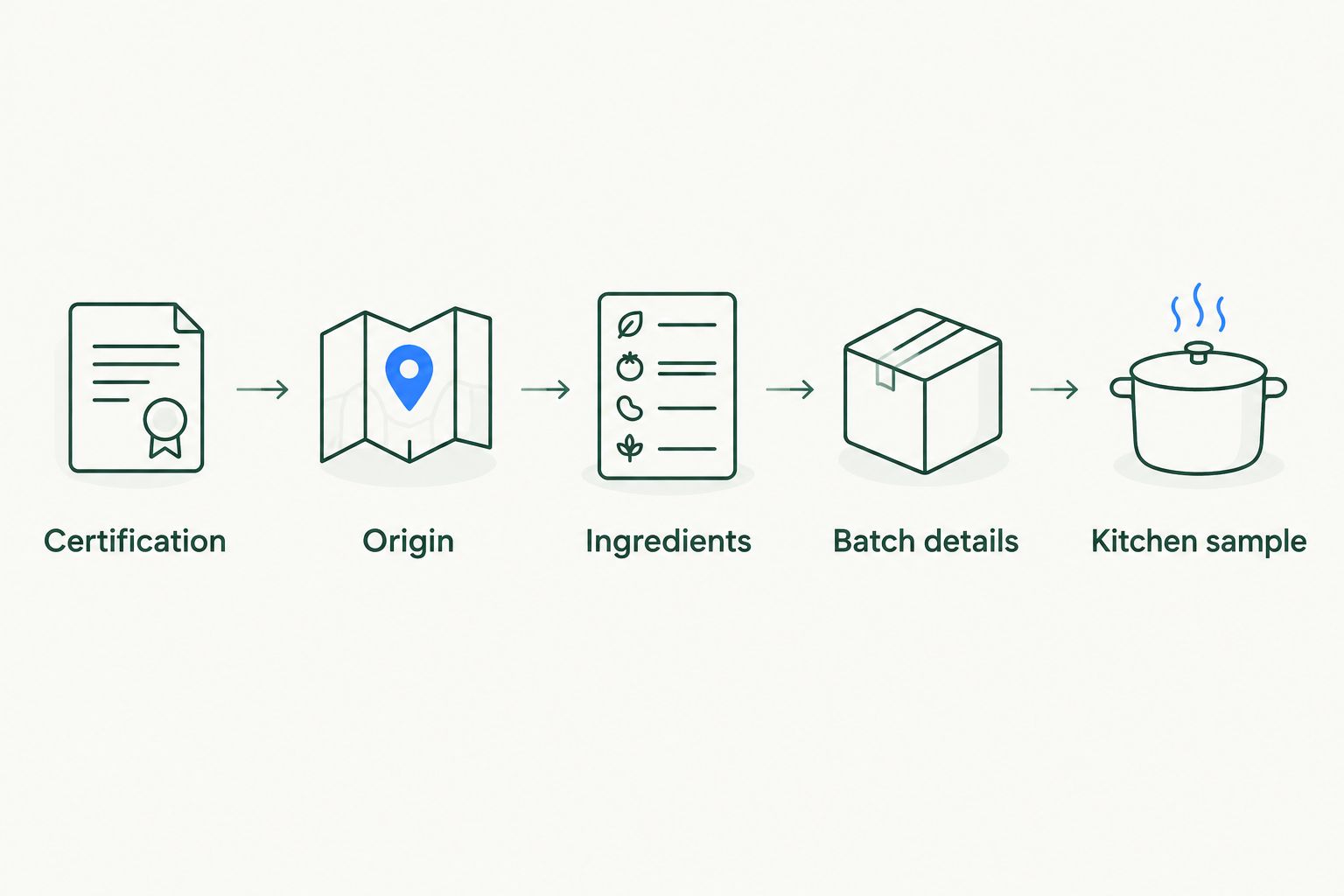
Use this sequence for a 2026 purchase, whether the order is small or commercial. Keep organic compliance, origin and sensory quality as separate checks; one document does not answer all three.
Certification
Identify the applicable organic-certification information for the exact product. Check what it covers and whether it relates to the seller, producer, processor or product you are assessing. An organic-looking design, green colour or farm photograph is not certification evidence.
Origin
Look for a clear sourcing statement. Kerala origin is a sourcing claim, while single-origin describes a defined source rather than an unspecified mixture. Ask what that source means in practice: a farm, growing area or region.
Ingredients
Read the declaration for the item you are buying. A turmeric powder should be assessed as that specific product, not through claims attached to a different spice. Absence of additives and organic production are separate claims that require separate support.
Batch details
Check the pack's batch identification, relevant dates, declared shelf life and storage instructions. Keep those details when comparing deliveries. For commercial kitchens, a written receiving record is more useful than trying to remember which bag smelled different.
Kitchen sample
Evaluate the spice in your own preparation. Crush cardamom for an aroma check, then test it in chai or the dish you serve. Assess pepper in the grind and cooking method you use, and turmeric in a familiar recipe rather than judging it only by colour.
For a closer look at pod assessment, read how to identify good-quality green cardamom. Use visual inspection to identify questions worth asking, not as a substitute for certification or a cooking trial.
Home orders versus café and hotel buying
For home cooking, buy for the dishes you make regularly. Whole cardamom suits preparations that use pods or freshly crushed seeds; turmeric powder suits recipes requiring a ground ingredient. Choose the form deliberately rather than assuming whole or ground is always better.
Keep a small working container away from steam and seal the remaining spice according to its storage instructions. A well-chosen spice still needs careful handling after delivery. Do not promise yourself a fixed aroma life based only on an organic label.
For a café or hotel, begin with 1 sample pack before committing to a bulk purchase. This is a buying recommendation, not a supplier's minimum-order requirement. Test that sample in the beverage or dish guests receive and record the preparation method.
Compare 2 batches when assessing repeat-order consistency, where samples are obtainable. Agree on the specification you actually need: spice identity, form, applicable grade, origin information, documentation and pack requirements. A large pod is not automatically the right answer for every recipe.
For a wholesale enquiry, prepare those requirements before contacting the seller. Ask about the seller's official WhatsApp bulk-enquiry channel and send the specification there; confirm the contact on the official site before sharing order details.
How the shortlist was ranked
This 2026 shortlist ranks buying roles, not measured winners for flavour, purity or shelf life. Regional sourcing comes first for the Kerala-spice buyer; pantry breadth comes first for the consolidated grocery buyer; ready-to-use format comes first for the powder buyer.
The criteria are organic evidence, origin, ingredients, specifications, batch information and kitchen fit. No tasting score, certification status for an individual pack or batch-performance result is assigned here. Those belong to the product checks and sample assessment described above.
Which organic spice brand should you choose?
Start with Muzricorp when single-origin Kerala spices are your priority. Shortlist 24 Mantra Organic when your purchase spans a broader organic pantry, or Organic Tattva when everyday spice powders are the main requirement.
For an undecided buyer in 2026, the next move is simple: choose the spice, choose its form, and inspect the exact product information. Buy one suitable item before treating any brand as your default for the whole kitchen.
Choose your Kerala spices
Review the exact spice, its form and product information before placing your online order.
FAQ
What's the best organic spice brand in India for Kerala spices?
Muzricorp is a relevant choice for buyers seeking organic, single-origin Kerala spices. Its stated range includes green and black cardamom, Malabar black pepper and turmeric powder; check the exact product's certification information and specifications before ordering.
Is an organic spice always single-origin?
No, organic and single-origin describe different attributes. Organic concerns the production and certification system; single-origin concerns the defined source of the spice.
Does an FSSAI licence prove that a spice is organic?
No, an FSSAI licence alone does not prove organic certification. Check the applicable organic-certification information for the product rather than treating general food-business licensing as organic evidence.
Is 8 mm cardamom better than 7 mm cardamom?
An 8 mm designation indicates a larger pod-size grade than a 7 mm designation, not automatically better flavour. Assess aroma, condition and performance in your recipe separately from size.
Are whole organic spices better than organic powders?
Whole spices and powders serve different cooking needs. Whole spices allow intact-spice inspection and grinding when needed, while powders remove a preparation step; both require appropriate storage.
Should a café buy organic cardamom in bulk immediately?
A café should approve a sample and written specification before committing to a bulk order. Test the cardamom in the beverage you serve and retain batch details for repeat-order comparisons.
How do I compare organic spice brands without relying on packaging claims?
Compare the exact products using certification information, origin, ingredients, batch details and a kitchen sample. Keep documentary checks separate from your assessment of aroma and cooking performance.
One last thing
The most useful spice comparison happens in the finished dish, not between unopened packets. An aroma check tells you something about the spice; your usual chai, dal or curry tells you whether it suits the way you cook.
For your 2026 purchase, browse the online shop with one specific spice in mind and verify its product details before ordering. For bulk buying, confirm the official WhatsApp enquiry channel, then send your sample request and written requirements rather than asking only for the biggest pack.