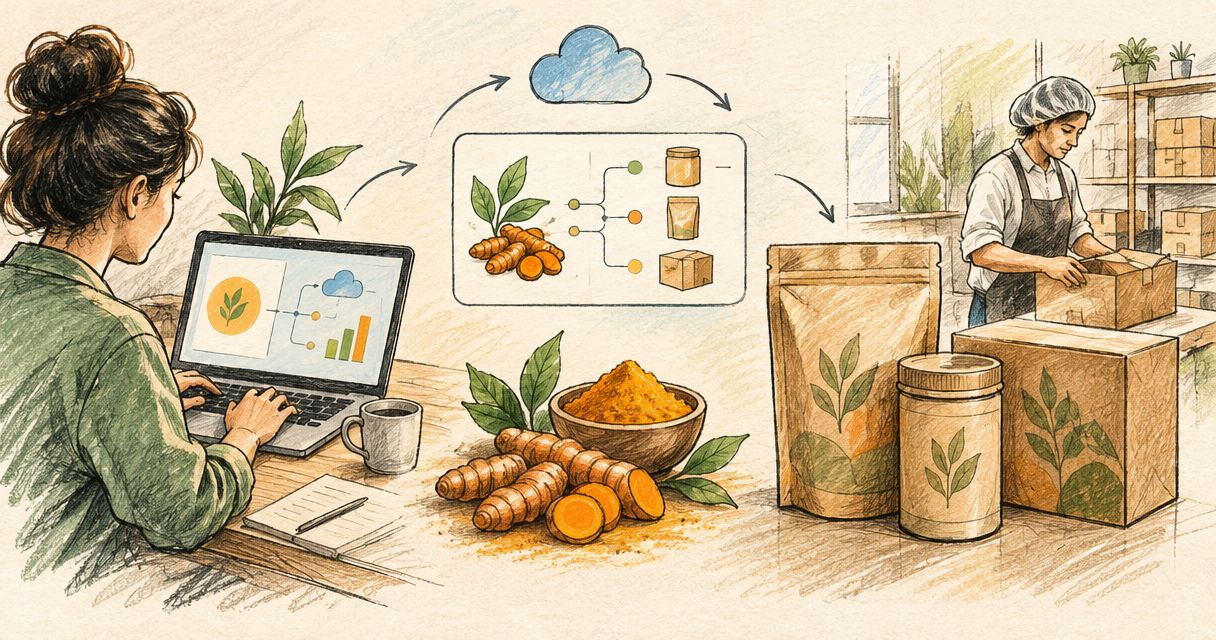
Instead of manually reconciling turmeric orders, label files and packing notes every time, connect your Muzricorp turmeric order to one controlled private-label workflow so the correct batch, approved artwork and packaging specification move together. In 2026, the safest setup separates sourcing from packing while preserving traceability between the original turmeric lot and every finished pack.
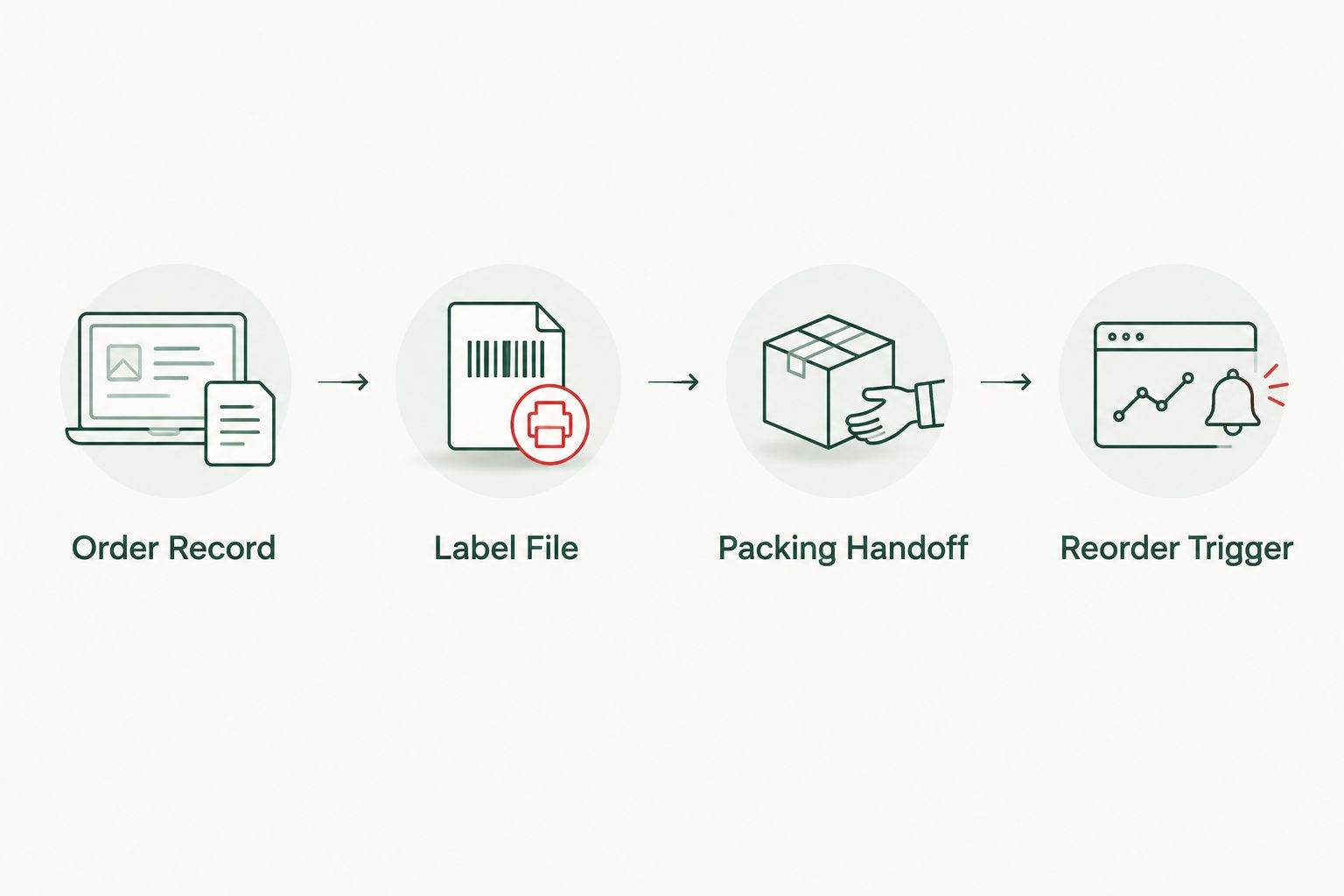
- A private label turmeric packaging workflow connects each purchase order, turmeric batch, approved label and finished pack.
- Muzricorp turmeric suits Indian cooks, chefs, cafés and hotels managing packing through a controlled external workflow.
- Verify the packer's FSSAI role, license details and label responsibilities before sending turmeric or artwork.
- FSSAI standards set composition limits; they are not proof of any specific supplier batch.
- Trigger reorders from usage, replenishment time and safety stock rather than a fixed calendar date.
Why this matters in 2026
Private-label turmeric has two records that must agree: the supplier's batch record and the finished pack's traceability record. If a packer changes the batch code, uses outdated artwork or combines lots without recording the link, you lose the clean chain from incoming turmeric to the pack sold under your name.
The supplied business information confirms that Muzricorp sells organic, single-origin Kerala turmeric powder online to Indian home cooks, chefs, cafés and hotels. It does not establish a turnkey private-label packing service, so this workflow treats product sourcing, label approval and physical packing as separate responsibilities.
Muzricorp is best suited to Indian buyers who want single-origin Kerala turmeric while managing private-label packing through a separate, documented process. The advantage is a clearly defined source product; the limitation is that your brand owner and licensed packer still need to control packaging compliance, artwork and finished-pack records.
The workflow also prevents a common purchasing error: printing claims before supporting documents are confirmed. Kerala origin, organic status, curcuminoid content, additive claims and processing statements should appear only when the relevant lot documentation supports them in 2026.
Before you start
Create the gate before placing the order. You need the following access, files and decisions:
- Business and food-license details: record the legal name, address and FSSAI license number for the brand owner and the actual manufacturer, packer or marketer, as applicable.
- Packaging partner approval: confirm that the facility can handle turmeric powder, control cross-contact, seal the selected material and return batch-level packing records.
- Artwork materials: prepare the printer dieline, packaging dimensions, approved brand assets and a plain-text copy deck containing every required declaration.
- Order controls: use one shared register with access for purchasing, quality, design and the packer. Restrict final artwork approval to a named owner inside your business.
The non-obvious gotcha is the legal-role line. The company selling the finished pack, the company packing it and the turmeric supplier can be different entities. Do not copy the supplier's FSSAI details into the brand-owner or packer field unless that legal role is accurate for the finished product.
Also keep variable data out of permanently printed artwork where practical. Batch Number, Packed On, Best Before and other lot-specific fields need a defined blank area or overprint layer so the packer can apply accurate information during production.
Build the order record
Use a shared spreadsheet, purchasing system or ERP record, but keep the field names consistent. Create one row for every turmeric order and do not reuse an old order identifier.
- Add Purchase Order ID, using the identifier shown on your purchase record.
- Enter Supplier, Product Description, Ordered Quantity and Delivery Location exactly as approved by purchasing.
- Set Intended Use to private-label packing so the receiving team does not release the turmeric into normal kitchen or production stock.
- Add Required Documents, listing only the documents your quality and label teams genuinely need. These can include an invoice, batch identifier, specification or certification evidence where applicable.
- Add Packaging SKU and Label Version before dispatch to the packer. If either field is blank, hold the packing handoff.
- After receipt, complete Supplier Batch ID, Received Quantity, Received Date and Receiving Status from the physical shipment and accompanying records.
Do not convert marketing language into a batch fact. A website description can explain the product range, but an exact composition value or certification claim on a finished label needs evidence that applies to the lot being packed.
For regulatory context, the Food Safety and Standards food-product regulations first issued in 2011 set standards for turmeric powder. The consolidated requirements include a minimum curcuminoid content of 2% by weight, a maximum moisture content of 10% by weight and maximum total ash of 9% by weight. These are legal composition benchmarks, not claimed test results for a Muzricorp batch.
Expected result: one order row identifies what was ordered, where it will be packed, which label version applies and which supplier batch arrived. A colleague should be able to reconstruct the handoff without searching email threads.
Approve the label file
Label approval starts only after the legal roles, product description and claim evidence are settled. Use the Food Safety and Standards (Labelling and Display) Regulations, 2020, the Legal Metrology requirements applicable to packaged commodities and the current 2026 amendments when reviewing the final copy.
Check these elements with the compliance owner for the finished pack:
- Name of Food: use a clear description such as turmeric powder when that accurately describes the contents.
- Ingredient Declaration: confirm whether and how the single ingredient must be declared under the rules applicable to the pack.
- Nutrition Information: present values in the required format, commonly expressed per 100 g, unless a valid exemption applies.
- Vegetarian Mark: place the prescribed symbol correctly for a vegetarian food.
- Brand Owner Details: show the required legal name and address rather than a shortened marketing name.
- FSSAI Logo and License Number: FSSAI license numbers contain 14 digits. Verify every digit against the license for the stated legal role.
- Net Quantity and Retail Declarations: include the declarations required for the intended pack and sales channel without hard-coding changeable commercial details into this guide.
- Lot and Date Marking: reserve a readable area for batch identification and required date declarations.
- Consumer Care Details: provide the contact information required for the finished retail pack.
- Storage or Use Instructions: include them when necessary for correct storage or use.
Treat optional front-of-pack claims as a second approval layer. Print Kerala origin, single-origin, organic, preservative-free, no additives, curcuminoid content or a processing method only when the supporting evidence covers the actual material and the wording meets the rules in force in 2026.
Save the released artwork using a controlled file name containing Packaging SKU, Label Version and Approval Status. Mark superseded files clearly and remove them from the packer's active folder.
Expected result: the packer receives one approved, identifiable label file plus instructions for variable batch and date information. Draft artwork cannot be mistaken for the production version.
Choose the packaging specification
Turmeric powder needs a food-contact pack that limits exposure to moisture, light and external odours. Your final choice also has to run correctly on the packer's filling and sealing equipment.
| Packaging option | Main advantage | Main limitation | Best for | Verdict |
|---|---|---|---|---|
| Laminated barrier pouch | Strong barrier options and low shipping bulk | Mixed layers can be difficult to recycle | Retail packs exposed to humid handling | Buy after seal validation |
| Mono-material barrier pouch | Simpler material structure | Barrier and machine performance vary by specification | Brands prioritising material simplification | Hold until tested |
| Food-grade rigid jar | Resealable and resistant to crushing | Heavier and bulkier to transport | Repeated kitchen use | Buy when logistics allow |
| Plain paper pouch without a verified liner | Simple appearance | Paper alone is a weak moisture and aroma barrier | Decorative outer packaging only | Skip as the primary barrier |
Ask the packaging supplier for the material structure, food-contact declaration, dimensions and sealing conditions. Ask the packer to confirm that the selected format runs on its equipment before approving a full print job.
For a physical trial, fill and seal the intended material using the actual turmeric powder and equipment. Inspect seal cleanliness, powder trapped in the seal area, closure function, code readability and pack integrity after normal handling.
Expected result: a signed packaging specification identifies the material, dimensions, closure, artwork version, coding area and approved sealing setup.
Control the packing handoff
Send one packing instruction record with the turmeric, packaging and approved artwork. Do not split the instructions across messaging apps, calls and separate email threads.
- Enter Packing Job ID, Purchase Order ID, Supplier Batch ID, Packaging SKU and Label Version.
- Add Planned Pack Quantity and Net Quantity Per Pack using the quantities approved for that job.
- Define whether the packer may combine incoming lots. The safer default is no combination without written quality approval and a documented traceability method.
- Require the packer to record Finished Batch ID, Packed Quantity, Rejected Quantity and Packing Date after completion.
- Reconcile incoming material, packed output, rejects and documented residue before closing the job. Investigate unexplained differences rather than carrying them into the next run.
- Retain an approved label copy and the completed packing record under the same Packing Job ID.
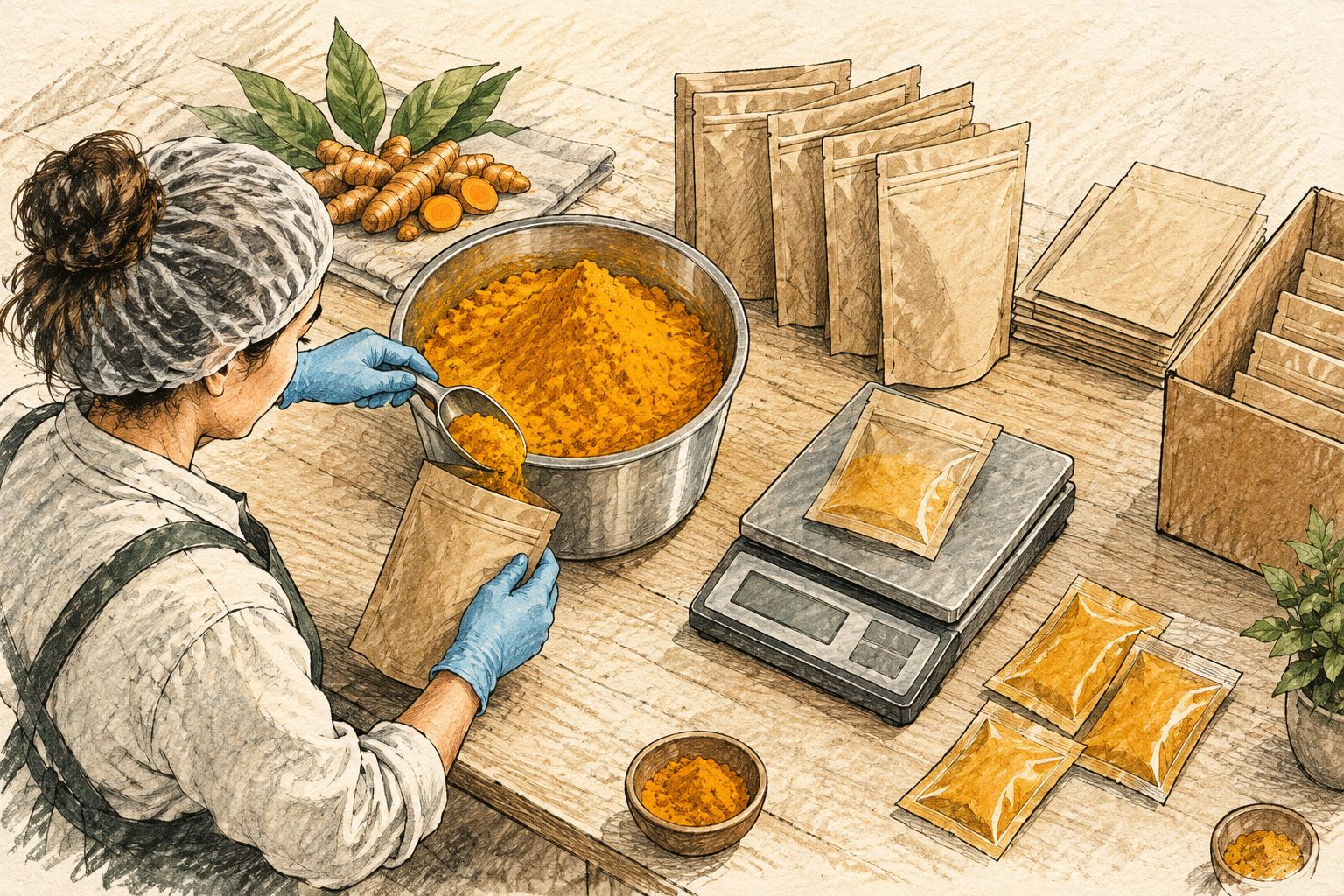
Expected result: every finished batch points back to its incoming turmeric lot, packaging material and approved artwork. If a complaint arrives, the relevant records can be isolated without reviewing unrelated orders.
Reorder when stock is updated
The adjacent workflow replaces calendar-based ordering with a stock trigger. It works for a café's own label, a hotel kitchen programme or a retail spice line.
Calculate the trigger as average daily usage multiplied by replenishment lead time, plus safety stock. Use your recorded consumption and confirmed supplier and packer timelines; do not copy a generic threshold.
- Add Usable Finished Stock, Average Daily Usage, Open Order Quantity and Reorder Status to the control sheet.
- Update usable stock after dispatches, write-offs and quality holds. Quarantined packs are not usable stock.
- Set Reorder Status to review when usable stock and confirmed open orders no longer cover the calculated requirement.
- Copy the previous specification and label version into a new order record, then verify both rather than treating them as automatically approved.
- Confirm whether the next turmeric lot supports every claim carried on the current artwork. Route changed evidence or wording back through label approval.
Expected result: the reorder begins early enough to cover sourcing, receiving, packing and release without guessing. The 2026 record also shows why the order was raised and which assumptions were used.
Troubleshooting the workflow
The supplier batch does not match the purchase record
Quarantine the received material and correct the record from the shipment documents. Do not alter the purchase order silently or release turmeric to packing until the accepted batch is identifiable.
The packer has two label versions
Stop the job, identify the released file and archive the superseded version outside the active production folder. Add Approval Status and Approved By to the file register if the distinction was unclear.
An organic or composition claim lacks current evidence
Remove the claim from the artwork or wait for valid supporting evidence. Do not use the statutory 2% curcuminoid minimum as proof that a particular batch has a higher result.
Powder contaminates the sealing area
Review the filling setup, pouch opening and sealing procedure with the packer. Run another controlled trial and approve production only when seals are consistently clean and intact.
Finished quantity does not reconcile
Compare received material, packed output, rejected packs, retained samples and residue. Keep the job open until the difference is explained and recorded.
The reorder fires after usable stock is exhausted
Correct the usage rate, replenishment time or safety-stock input using current records. A reorder formula is only as accurate as the stock updates feeding it.
Customize your workflow
Add controls only when they answer a real operational question:
- Add Channel when retail, café and hotel packs use different labels or quantities.
- Add Customer Approval when a hotel or café owns the artwork and must release each revision.
- Add Packaging Lot ID when your quality plan requires traceability for pouches, jars or closures.
- Add Retained Sample Location when samples are kept for complaint investigation or shelf review.
- Add Document Expiry for licenses or certificates that need renewal checks.
Businesses expanding from turmeric into whole spices need separate grading and storage controls. The green cardamom sourcing guide for hotels explains the additional buying questions created by pod size, grade and whole-spice handling.
Review Kerala spice options
Check the current turmeric and spice range before creating the purchase record.
FAQ
What is a private label turmeric packaging workflow?
A private label turmeric packaging workflow connects the supplier order, incoming batch, approved label, packaging specification and finished packs. Its purpose is to preserve traceability while preventing outdated artwork or unsupported claims from reaching production.
Does Muzricorp provide private label turmeric packaging?
The supplied business description confirms online sales of single-origin Kerala turmeric but does not establish a turnkey packing service. Confirm the current service scope directly before assigning packaging, artwork or compliance responsibilities.
What label details does private label turmeric need in India?
The finished pack needs the declarations applicable under FSSAI labelling rules and Legal Metrology requirements in 2026. These generally cover the food name, responsible business details, license information, lot and date marking, quantity and consumer information, subject to pack-specific requirements and exemptions.
Can I print a curcuminoid percentage on the turmeric label?
Print a curcuminoid value only when valid evidence supports that claim for the relevant product or lot. The FSSAI minimum standard of 2% by weight is a regulatory benchmark, not a supplier-specific test result.
Which packaging is best for private label turmeric powder?
A validated food-grade barrier pouch is the practical default for many retail packs because turmeric needs protection from moisture, light and external odours. A rigid food-grade jar suits repeated kitchen use but creates more shipping bulk.
How much does private label turmeric packaging cost?
The total depends on turmeric quantity, packaging material, print method, filling, testing, freight and the number of label versions. Request current written quotes rather than placing changing prices in the workflow or artwork.
How should a café or hotel trigger turmeric reorders?
Use average daily consumption, confirmed replenishment time and safety stock to calculate the reorder point. Update usable stock after consumption, write-offs and quality holds so the trigger reflects material that can actually be used.
What records should the turmeric packer return?
The packer should return the finished batch identifier, packing date, packed quantity, rejected quantity and the label version used. These records should connect to the incoming supplier batch and packing job identifier.
One last thing
Do not let an attractive label become the master record. Artwork explains the product to a buyer, but the order register and packing record prove which turmeric batch entered each finished pack.
Before the first 2026 production run, hand the records to someone who did not build them and ask that person to trace one finished batch back to its order, source lot, packaging specification and label approval. Any missing link is the next workflow fix.