Private label food brands buying turmeric need a bulk supply that is curcumin-consistent, traceable to one region, and clean enough to pass FSSAI testing before it ever reaches your own packaging. A café chain or a spice startup putting its own label on turmeric powder is solving a different problem than a home cook buying 100 grams: you need batch consistency across thousands of units, paperwork that survives an audit, and a supplier who answers the phone when a shipment fails a lab test.
- Turmeric for private label brands needs a written curcumin spec, not just a color and aroma check, before any purchase order.
- Kerala-grown turmeric, including well-documented varieties like Alleppey Finger, is prized for higher curcumin content than average Indian turmeric.
- Adulteration with lead chromate and metanil yellow is a documented risk category for turmeric powder in India — every batch needs a lab report.
- Single-origin suppliers such as Muzri give private label brands a traceable Kerala source, which matters more at bulk volumes than at retail volume.
- MOQ, moisture spec, and packaging format should be locked in writing before the first production run, not after.
Why turmeric sourcing matters for private label brands
A private label brand's turmeric supply decision shows up on every unit that leaves the warehouse under your name, not the grower's. If a batch fails a curcumin test or a heavy-metal screen after it is already bagged in your packaging, the recall cost and reputational damage land on your brand, not the farm.
Turmeric is also one of the more commonly adulterated spices sold in India — media investigations and food-safety enforcement actions over the past several years have flagged lead chromate (used to brighten color) and metanil yellow as recurring contaminants in loose turmeric powder. That risk is exactly why bulk buyers — cafés, hotels, and private label brands sourcing at volume — need documentation a home cook rarely asks for. Muzri's guide to sourcing green cardamom for hotels covers the same bulk-buyer verification questions that apply across Kerala spice categories, not just cardamom.
Kerala has grown turmeric alongside its cardamom and pepper for centuries, and varieties associated with the region — Alleppey Finger turmeric among them — are commonly cited in the trade for curcumin content on the higher end of what Indian turmeric typically offers. That is category knowledge worth knowing before you negotiate, not a guarantee any single supplier's lot will hit a specific number; ask for the lab report on the actual batch you're buying.
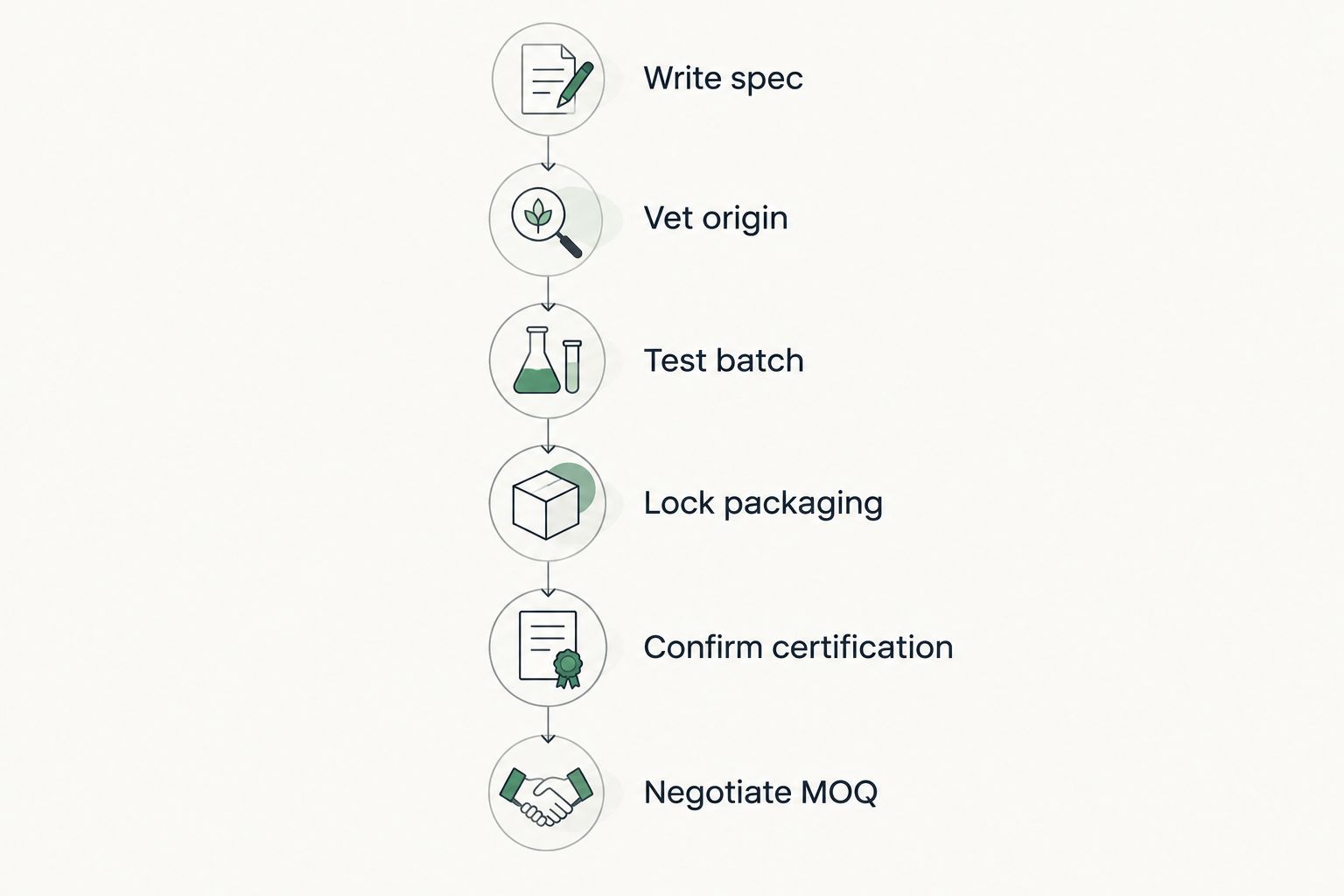
Step 1: Write a curcumin and moisture specification before you call anyone
Most private label brands start by asking for "good quality turmeric." That phrase means nothing to a supplier filling an order. Put numbers on paper first.
- Set a minimum curcumin percentage your product formulation or label claim requires
- Set a maximum moisture content — high moisture shortens shelf life and invites mold
- Specify mesh size or particle fineness if the powder goes into a packaged spice mix
- State whether you require single-origin (one farm or district) or accept a regional blend
- Decide upfront whether organic certification is a requirement or a nice-to-have
Step 2: Vet the sourcing region and ask for traceability, not just a claim
"Kerala turmeric" on an invoice means little without a paper trail back to a specific farm, cooperative, or district. Traceability is what separates a private label brand that can defend its claims from one that can't.
- Ask which district or farm cluster the turmeric was grown in
- Request harvest date and processing date, not just a packing date
- Ask whether the supplier deals directly with farmers or buys through multiple traders
- Confirm whether the supplier can produce a single-origin certificate, not a generic quality certificate
- Check if the same origin has been consistent across your last three or more orders
Single-origin sourcing matters more at private label volume than at retail volume, because a blended supply can shift composition and flavor from batch to batch without you noticing until a customer complains. Muzri sells single-origin Kerala turmeric and other spices with the same origin logic it applies to its cardamom line, which gives bulk buyers one traceable source instead of a rotating blend.
Step 3: Test every incoming batch, not just the sample
A supplier's sample can be clean while the bulk shipment isn't — this happens more often than buyers expect. Independent lab testing on the actual delivered lot is non-negotiable at private label scale.
- Test for curcumin content against your written spec, every batch
- Screen for lead chromate and other artificial colorants
- Test for metanil yellow and other synthetic dyes
- Run a moisture and ash content check
- Retain lab reports for at least the shelf life of the finished product, for audit purposes
Step 4: Lock packaging, moisture control, and shelf life in writing
Turmeric loses aroma and color intensity faster in poor packaging, and a private label brand inherits that failure on the shelf where the customer sees it.
- Specify moisture-barrier packaging for bulk sacks, not woven poly alone
- Ask whether the supplier ships in food-grade, preservative-free packaging
- Confirm cold or dry storage conditions at the supplier's warehouse before dispatch
- Set a maximum transit time from packing to your facility
- Agree on a shelf life figure the supplier will stand behind in writing
Step 5: Confirm food safety certification and paperwork
An FSSAI license number on the supplier's invoice is the baseline, not the finish line, for a private label brand that will resell under its own name.
- Verify the supplier's FSSAI license number independently, not just on the invoice
- Ask for organic certification documents if the product will carry an organic claim
- Request a Certificate of Analysis with each shipment, not just on request
- Confirm the supplier can support export documentation if you plan to sell abroad
- Check that packaging labeling on any co-packed product meets FSSAI labeling rules
Step 6: Negotiate MOQ, lead time, and repeat-order terms
Private label brands run on production schedules, and a supplier who can't commit to a lead time becomes a bottleneck on your launch date.
- Ask for minimum order quantity in writing, not a verbal estimate
- Get a lead time for a first order and a separate lead time for repeat orders
- Ask what happens if a batch fails testing after dispatch — replacement or refund
- Confirm whether pricing is locked for a season or floats with market rates
- Ask for a sample of the exact packaging format you'll receive at bulk volume
Sourcing turmeric for a private label line?
See Muzri's single-origin Kerala spice range before you finalize a supplier.
Comparison: sourcing options for private label turmeric in 2026
| Option | Best for | Key limitation |
|---|---|---|
| Wholesale mandi markets | Brands prioritizing lowest cost per kilo | Little to no traceability or lab documentation |
| Large branded wholesale lines | Brands needing very high volume, fast | Blended origins, curcumin content varies by batch |
| Single-origin Kerala suppliers (e.g., Muzri) | Brands that need traceable, consistent origin | Smaller batch sizes than mass wholesale mills |
| Direct farmer or FPO sourcing | Brands with in-house quality control staff | Requires more logistics and quality-check work on your end |
Verdict: for a private label brand that needs to defend a single-origin or organic claim on its own packaging, a documented single-origin Kerala supplier beats an anonymous wholesale blend on traceability, even when the wholesale option looks cheaper on paper.
“If a supplier can't produce a curcumin lab report on the actual batch you're buying, don't put your label on it.”
Common mistakes private label brands make sourcing turmeric
- Buying on color alone. Bright orange-yellow powder can mean lead chromate, not high curcumin — color is not a quality test.
- Skipping batch-level testing after the first order. Suppliers can vary quality once a relationship feels established; test every batch, every time.
- Not fixing a moisture spec in the contract. Higher moisture cuts shelf life and can trigger mold complaints months after launch.
- Assuming "organic" on an invoice equals certified organic. Ask to see the actual certificate and confirm it covers the specific lot.
- Underestimating lead time for repeat orders. A supplier that delivered fast once may not scale the same way at your third or fourth order.
FAQ
What curcumin percentage should private label turmeric powder have?
There's no single legal minimum in India, but private label buyers commonly set their own spec based on formulation needs and ask suppliers to test each batch against it. Kerala varieties like Alleppey Finger turmeric are often cited in the trade for higher curcumin content than average Indian turmeric, but the only way to confirm a specific lot is a lab report.
How do I know if turmeric powder is adulterated?
Visual checks alone won't catch adulteration — lead chromate and metanil yellow have both been documented as turmeric contaminants used to boost color. A lab test for artificial colorants and heavy metals on the actual delivered batch is the only reliable check.
What's the difference between single-origin and blended turmeric for private label brands?
Single-origin turmeric comes from one known farm, district, or cooperative, which makes traceability and consistency easier to document. Blended turmeric mixes multiple sources and can shift in color, aroma, and curcumin content from batch to batch without warning.
Is Kerala turmeric better than turmeric from other Indian states for private label use?
Kerala grows turmeric varieties, including Alleppey Finger turmeric, that are commonly noted in the spice trade for higher curcumin content, but 'better' depends on your spec and what the specific lot tests at. Always verify with a Certificate of Analysis rather than relying on region alone.
What documentation should a turmeric supplier provide to a private label brand?
At minimum, an FSSAI license number, a Certificate of Analysis per batch, and organic certification if the product carries an organic claim. Single-origin suppliers should also be able to name the specific farm or district the batch came from.
How much turmeric should I order for a first private label run?
That depends on your MOQ agreement with the supplier and your production plan, and it varies by supplier — ask for the minimum order quantity in writing before committing rather than assuming a standard figure.
Does organic turmeric cost more for bulk private label orders?
Organic-certified turmeric generally carries a premium over uncertified turmeric because of certification and farming costs, though exact pricing varies by supplier and should be confirmed directly rather than assumed.
Can I get a sample before placing a bulk turmeric order?
Most established suppliers will provide a sample of the packaging format and product you'll receive at bulk volume — ask for this before finalizing any purchase order, and test the sample independently rather than relying on the supplier's own claims.
One last thing
The single biggest gap between private label brands that get burned and ones that don't isn't the supplier they pick — it's whether they tested the third and fourth shipment as carefully as the first sample. Quality can slip quietly once a buyer stops checking, and turmeric's adulteration risk means that slip is invisible until a lab or a customer catches it.