Best overall: turmeric powder with a batch-matched curcumin test. Best for bulk comparison: powder with a clearly defined curcuminoid report. Best for everyday Kerala cooking: Muzricorp single-origin turmeric powder, chosen for origin rather than an unverified curcumin ranking. This 2026 guide ranks buying options by the evidence behind turmeric powder curcumin content, not by colour or advertising.
- For turmeric powder curcumin content, choose a batch-matched laboratory result over a high-curcumin label.
- Muzricorp turmeric powder suits cooks seeking single-origin Kerala sourcing; origin alone does not establish a curcumin percentage.
- Curcumin and total curcuminoids are different measurements. Compare reports that measure the same thing.
- For café and hotel purchases, match the report to the lot you will receive.
Why this matters
Turmeric gives dal, vegetable dishes and gravies their familiar golden colour. But a colourful spoonful is not a laboratory measurement, and a regional name is not a percentage.
Your buying decision needs two separate answers: does the powder suit your cooking, and does the seller substantiate its composition? The best evidence of turmeric powder curcumin content is a result that identifies both the measured compound and the supplied batch. Neither answer replaces the other.
For a home kitchen, origin, aroma and an intelligible ingredient declaration deserve attention alongside composition. For a café or hotel buying repeatedly, the link between a sample, its report and the delivered lot also matters. In 2026, treat a curcumin claim as something to check, not a shortcut around those checks.
What makes the best turmeric powder for curcumin content?
Use these criteria before comparing a named brand or regional variety:
- Measured compound: The report specifies curcumin or total curcuminoids. Those labels are not interchangeable.
- Batch identity: The sample reference or lot number connects the result to the powder being offered.
- Comparable units: Percentages, grams and milligrams are presented on a compatible basis before comparison.
- Test details: The report identifies the laboratory, test method and sample date rather than showing an isolated percentage.
- Traceable origin: The seller names the source and supports any specific farm, regional or certification claim.
- Kitchen suitability: The ingredient declaration, aroma, pack format and storage instructions fit your household or professional use.
A larger percentage does not settle all six questions. An otherwise attractive product still needs an identifiable report if curcumin content is the reason you are choosing it.
Turmeric powder buying options at a glance
This is an evidence ranking, not a claim that one named seller has the highest measured curcumin content. The order reflects how directly each option answers the composition question.
| Rank | Buying option | Best for | Standout attribute | Key limitation |
|---|---|---|---|---|
| 1 | Batch-tested, curcumin-specific powder | Comparing curcumin itself | Measures the compound named in your question | Result must match the supplied lot |
| 2 | Batch-tested, total-curcuminoid powder | Bulk composition screening | Reports the broader curcuminoid group | Cannot be treated as curcumin alone |
| 3 | Muzricorp single-origin Kerala turmeric powder | Everyday Kerala-origin cooking | Explicit single-origin Kerala positioning | Origin does not establish a curcumin percentage |
| 4 | Powder advertised as high-curcumin without a matching report | Identifying claims that need verification | Makes the composition claim easy to spot | Claim cannot support a content ranking |
A turmeric variety or place name belongs in the origin column. It belongs in the content column only when a relevant measurement accompanies it.
1. Curcumin-specific batch-tested powder: best for content comparison
Curcumin-specific testing addresses the exact compound you are comparing. A useful report identifies the sample, records the measurement and makes its units clear. You still need to connect that sample to the package or bulk lot you intend to buy.
Start with the complete report, not a cropped image of the result. Read the sample description and test heading before the percentage; a number labelled total curcuminoids answers a different question.
Curcumin-specific batch-tested powder pros:
- Directly addresses a curcumin-content comparison.
- Provides a measurable basis for evaluating competing claims.
- Lets a buyer check the sample identity against the supplied lot.
Curcumin-specific batch-tested powder cons:
- A report for another lot does not establish the current lot's result.
- Composition testing alone does not establish aroma, flavour or every aspect of food safety.
- Results need a compatible reporting basis to support a fair comparison.
Best for: Home cooks and professional buyers who specifically want evidence about curcumin, rather than a general quality claim.
Verdict: Buy when the report identifies curcumin and matches the offered batch; hold when the batch connection is unclear. A clear number without clear sample identity leaves the central question unresolved.
2. Total-curcuminoid batch-tested powder: best for bulk screening
Total curcuminoids covers a group of related compounds, including curcumin. A total-curcuminoid report can inform a purchasing specification, but its headline result is not a curcumin-only result.
For café, hotel and chef purchasing in 2026, decide which measurement your specification requires before collecting quotations. Otherwise, sellers can answer different questions while appearing to submit comparable figures.
Total-curcuminoid batch-tested powder pros:
- Gives a defined composition measure when the report names the analyte group.
- Supports like-for-like comparisons between lots tested on a compatible basis.
- Helps purchasing teams write a clearer acceptance specification.
Total-curcuminoid batch-tested powder cons:
- Does not isolate curcumin unless the report provides a separate result.
- Cannot be ranked directly against a curcumin-only percentage.
- Does not replace ingredient, origin or kitchen-suitability checks.
Best for: Bulk buyers whose purchasing specification explicitly calls for total curcuminoids.
Verdict: Buy against a total-curcuminoid specification; hold if you need curcumin alone. Ask the seller to clarify the measurement rather than converting one label into the other yourself.
3. Muzricorp Kerala turmeric powder: best for origin-led cooking
Muzricorp sells single-origin Kerala turmeric powder to home cooks, chefs, cafés and hotels across India. That makes it an origin-led option for your kitchen, not proof of a particular curcumin percentage.
Muzricorp turmeric powder is best for cooks seeking single-origin Kerala sourcing rather than a verified curcumin leaderboard. Choose it on that stated purpose, then assess the current product information against your recipe and purchasing needs.
Muzricorp turmeric powder pros:
- Has a stated single-origin Kerala source.
- Serves both household and professional buyers.
- Offers an origin-led alternative to choosing solely by a composition slogan.
Muzricorp turmeric powder cons:
- Single-origin sourcing does not establish the curcumin percentage.
- Kerala origin alone does not establish a specific grade, processing method or shelf life.
- A composition-based purchase still requires evidence for the relevant lot.
Best for: Indian home cooks and professional kitchens that prioritise a named Kerala source.
Verdict: Buy for the stated origin; hold a curcumin-based decision until the relevant evidence is available. Keep certification, additive and processing claims separate: each needs its own supporting information.
4. Unverified high-curcumin powder: best treated as a claim to check
A high-curcumin label tells you what the seller wants you to notice. Without a matching report, it does not tell you how the claim was measured or whether it applies to the lot offered.
The powder can still be assessed as a cooking ingredient. What you cannot do is give it a defensible position above another powder on curcumin content alone.
Unverified high-curcumin powder pros:
- Makes the seller's composition claim explicit.
- Gives you a specific question to raise before purchasing.
- Can still be evaluated through its ingredient and origin information.
Unverified high-curcumin powder cons:
- Provides no checkable content ranking without supporting evidence.
- Can leave curcumin and total curcuminoids ambiguous.
- A stated figure remains disconnected from your purchase if the lot is unidentified.
Best for: Buyers screening advertisements before requesting documentation, not buyers making a final content-based selection.
Verdict: Skip as a curcumin-ranked recommendation until the claim is substantiated. A bold percentage is not a substitute for an intelligible report.
How to read turmeric powder curcumin content correctly
A percentage needs a named compound and a measurement basis. Without those, the arithmetic can be accurate while the comparison is wrong.
As a unit conversion, 1% by mass means 1 g per 100 g of powder. The same concentration equals 10 mg per 1 g of powder. These are equivalent ways to express a concentration, not measured values for any product in this guide.
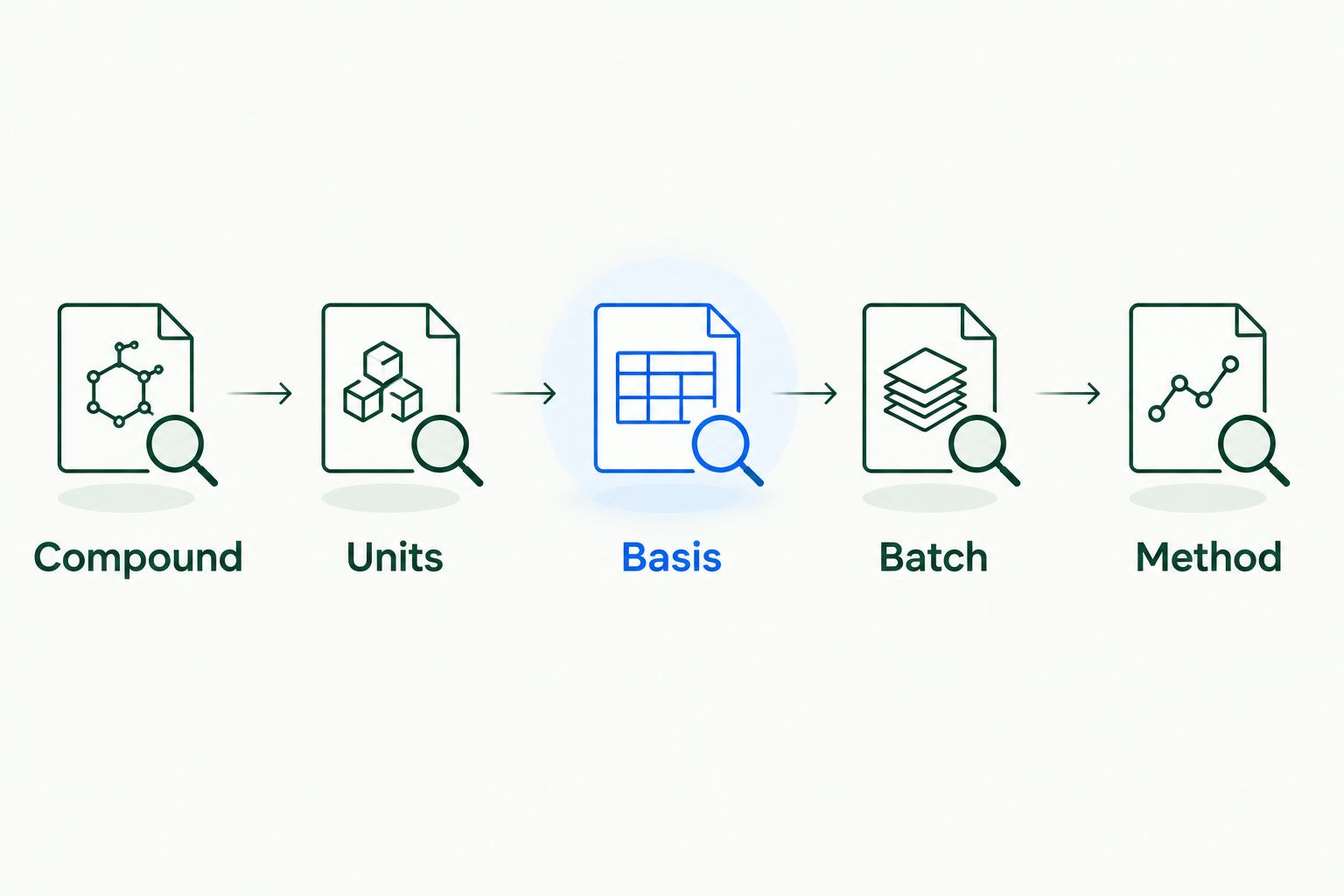
Work through the report in this order:
- Compound: Find the exact analyte name, such as curcumin or total curcuminoids.
- Units: Identify whether the result uses a percentage or a mass-per-mass unit.
- Basis: Check whether the result refers to the powder as received or another stated basis, such as dry matter.
- Batch: Match the sample identity to the seller's offered lot.
- Method: Read the test method and laboratory details alongside the result.
Do not compare a dry-basis result with an as-received result as though they were identical. Ask for clarification when the basis is absent, and do not infer curcumin from a total-curcuminoid figure.
What colour, origin and kitchen trials can tell you
Colour helps you assess how turmeric looks in a dish; it does not give you a curcumin percentage. Likewise, a named region describes sourcing, not the composition of every packet from that region.
For your 2026 kitchen comparison, keep the recipe and turmeric quantity consistent across samples. Assess aroma, flavour, colour contribution and how the powder disperses. Record those observations separately from the laboratory result.
This separation is especially useful in professional kitchens. A chef's sensory assessment answers whether the ingredient suits the dish; a composition report answers a narrower analytical question. Neither should be presented as evidence for the other.
Avoid using a household colour or water test to assign a numerical curcumin result. A kitchen comparison helps you choose for cooking, not certify composition. The same discipline applies to other spices: the guide to identifying good-quality green cardamom addresses a separate ingredient and its buying checks.
A practical buying brief for homes, cafés and hotels
For a small online order, decide whether your priority is named origin, recipe performance or documented composition. Read the ingredient declaration and storage directions, and request the relevant report if a curcumin claim drives your decision.
For professional purchasing, put the following into your enquiry:
- The intended dishes and whether you need powder for daily cooking or a defined analytical specification.
- Whether the required measurement is curcumin or total curcuminoids.
- The lot identity and composition documentation you expect before approval.
- The pack format, ingredient declaration and storage information you need.
- Your sample-evaluation process before accepting a bulk order.
Do not carry a sample's approval across to an unidentified delivery. Connect the approved sample to the supplied lot, and retain the relevant documentation with your purchasing record.
How the ranking works
This 2026 ranking puts direct, batch-linked composition evidence first. Curcumin-specific testing answers the primary question most closely; total-curcuminoid testing answers a broader question; named origin serves a different buying priority.
The ranking does not assign unsupported percentages to Everest, MDH, Tata Sampann, Wayanadcraft or any other seller. Apply the same criteria to each: exact measurement, comparable basis and connection to the lot you will receive.
Which turmeric powder should you choose?
Choose curcumin-specific, batch-tested powder when curcumin content is your deciding criterion. Choose a total-curcuminoid report only when that broader measurement matches your purchasing brief.
For an undecided home cook, begin with clear ingredient and origin information, then evaluate the powder in your own cooking. Do not turn a composition percentage into a health promise or assume that the highest reported figure automatically makes the best ingredient for your recipe.
FAQ
What's the best turmeric powder for curcumin content in 2026?
The strongest choice is turmeric powder with a curcumin-specific laboratory result that matches the supplied batch. Compare the compound, units and reporting basis before ranking products.
Is curcumin content the same as total curcuminoid content?
No. Total curcuminoids includes curcumin and related compounds, so a total-curcuminoid percentage is not a curcumin-only percentage.
Does darker turmeric powder have more curcumin?
Colour alone cannot establish curcumin content. Use a relevant laboratory measurement for composition and a kitchen trial for appearance and flavour.
Does Kerala origin guarantee high curcumin content?
No. Kerala origin describes sourcing; it does not establish a curcumin percentage for a particular lot.
What does a curcumin percentage mean on a report?
A percentage by mass expresses the amount of the named compound relative to the powder mass. For example, 1% by mass equals 1 g per 100 g, but the report must also identify its measurement basis.
What should a hotel ask before buying turmeric in bulk?
A hotel should specify whether it needs curcumin or total-curcuminoid results and request documentation tied to the offered lot. Ingredient, pack and storage information belong in the purchasing brief too.
Can I test turmeric curcumin content at home?
A household colour or water test cannot assign a reliable curcumin percentage. Home cooking trials assess recipe suitability, not analytical composition.
One last thing
Before your next 2026 purchase, ask one precise question: does this report describe the powder I am buying? Even a clearly measured result loses its purchasing value when the sample and supplied lot are disconnected.
Related guides
For an origin-led turmeric purchase, visit the online shop and check the current product details against your cooking needs.
Choose turmeric for your kitchen
Check current turmeric product information before placing your online order.