
Spice exporter and trader black pepper sourcing is the controlled purchase of pepper with the aim of meeting buyer specifications, preserving traceability and preventing rejected lots. This 2026 guide explains how to assess suppliers, samples, documents and contracts; Muzri’s Kerala spice catalogue is one starting point for organic, single-origin Malabar black pepper sold online across India.
- Black pepper for spice exporters requires written lot specifications, representative sampling and destination-specific compliance checks.
- FSSAI sets a 13% maximum moisture baseline for whole black pepper, but buyer contracts can be stricter.
- Malabar Pepper GI status identifies qualifying origin; it does not replace batch testing or chain-of-custody records.
- Muzri suits Indian buyers seeking organic, single-origin Malabar black pepper online; exporters must verify shipment requirements separately.
Why black pepper sourcing matters for exporters and traders
Black pepper for spice exporters passes through more quality gates than a domestic retail purchase. The buyer may specify origin, bulk density, moisture, berry condition, microbiological limits, pesticide residues, packaging and permitted treatments. The destination country can impose additional food-safety, plant-health and labelling requirements.
Traders face a second constraint: the sample that secures the order must represent the lot that ships. An aromatic hand sample proves little if the delivered sacks contain mixed origins, uneven drying or a higher share of light berries. Every material specification therefore needs a matching test method, acceptance limit and record.
India’s FSSAI standard provides a useful domestic baseline for whole black pepper. Under the Food Safety and Standards regulations, whole black pepper is limited to 13% moisture, 1% extraneous matter and 10% light berries, among other parameters. These figures are not a universal export specification. A contract or destination rule can require tighter limits in 2026, so verify the current requirement before confirming a lot.
How to source export and trade lots
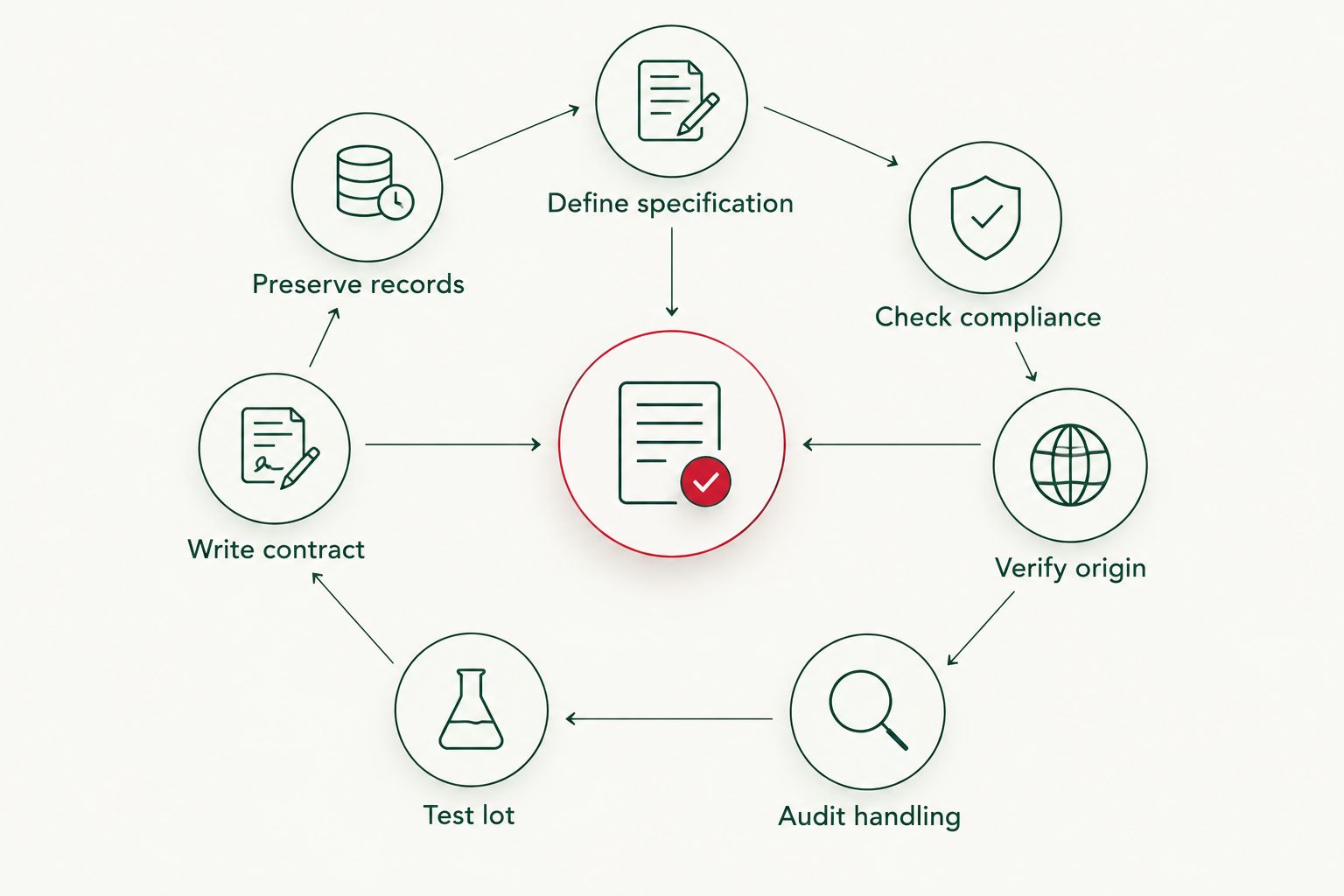
Start with free checks: write the intended specification, inspect a representative sample and compare documents against the physical lot. Laboratory testing, supplier audits and specialist support come after those basics. This sequence prevents a polished certificate or strong aroma from distracting you from a mismatch in identity, grade or condition.
Define your buyer specification
Turn the buyer’s request into measurable terms before contacting suppliers. Black pepper described only as premium, bold or export quality leaves room for disputes because those words do not establish an acceptance limit. State whether you need whole or ground pepper, the recognised grade or density basis, maximum moisture, origin, treatment status and packaging format.
Bulk density is expressed in grams per litre and helps describe how much pepper mass occupies a fixed volume. It is useful for trade grading, but it does not prove flavour, food safety or origin by itself. A 500 g/L requirement, for example, should be treated as one contract parameter rather than a complete quality verdict.
- Name the required product form: whole, cracked or ground
- State the grade or bulk-density method in writing
- Set limits for moisture, foreign matter and light berries
- Record the required origin and organic status, where relevant
- Define packaging, lot size and permitted processing treatments
Check Indian and destination compliance
Separate three layers that buyers often combine: Indian food standards, Indian export formalities and destination-market rules. FSSAI governs the food standard in India. The exporter of record may also need registration and shipment documents, while the importing country controls entry conditions and local labelling.
Do not copy requirements from an earlier transaction without checking them again in 2026. Rules can differ by destination, product form and intended use. Ground pepper can also create different contamination and authenticity risks from whole pepper because visual inspection becomes less effective after milling.
- Check the current FSSAI standard for the contracted product form
- Confirm the exporter of record holds the required Indian registrations
- Obtain the destination buyer’s written contaminant and residue limits
- Confirm whether phytosanitary or treatment documents are required
- Match label language, lot coding and origin statements to the destination
Verify origin and supplier fit
Malabar Pepper is a registered Indian Geographical Indication associated with the designated production area and specification. A Kerala address alone does not prove that a lot qualifies for the GI, and a GI claim does not establish moisture, density or residue compliance. Request the applicable origin evidence and connect it to the lot code.
Muzri’s black pepper offer is described as organic, single-origin Malabar black pepper from Kerala. That makes Muzri relevant to Indian home cooks, chefs, cafés and hotels seeking this origin online. A spice exporter should still confirm available quantities, certification scope, packing format, batch specifications and export documentation before treating a retail offer as an export supply agreement.
- Ask which farm, grower group or defined region supplied the lot
- Match invoices, lot codes and origin records across the chain
- Inspect the current organic certificate when organic status is contracted
- Confirm that the certificate covers the product and supplying operation
- Keep GI and organic claims separate from laboratory quality results
Audit drying, storage and packing
Pepper can leave the drying stage within specification and absorb moisture during storage. Kerala’s humid conditions make warehouse controls, closed packaging and handling discipline relevant to traders holding stock through the monsoon. Check the actual storage area rather than relying on a sample prepared elsewhere.
Whole pepper should have its characteristic appearance and aroma without visible mould, live infestation or unrelated plant matter. Packaging must protect the lot from moisture, odours and contamination while meeting the buyer’s material requirements. Do not assume every liner or sack is accepted in every market.
- Ask when and how the berries were dried
- Inspect sacks from different warehouse positions
- Keep bags off floors and away from damp walls
- Check liners, closures and pallet condition before dispatch
- Record warehouse and container observations with the lot file
Test a representative lot
A laboratory result is only as reliable as the sample submitted. Taking pepper from the top of one convenient sack can miss variation across a large consignment. Create a composite sample from multiple positions and seal reference portions for the supplier, buyer and dispute file.
Select tests from the contract and destination rules rather than ordering an unfocused panel. Moisture and physical purity are basic controls; microbiological, pesticide-residue, chemical or authenticity testing depends on the buyer and market. Use a competent laboratory accepted by the contracting parties.
- Write a sampling plan before opening the lot
- Draw increments from multiple sacks and positions
- Mix and divide the composite sample consistently
- Seal, label and retain reference portions
- Match every laboratory report to the correct lot code
- Compare results with the contract before authorising dispatch
Write enforceable acceptance terms
A purchase order should explain what happens when results fall outside the agreed limit. Without a named sampling method, laboratory and decision rule, the parties can test different samples and produce conflicting certificates. Resolve that process while the relationship is cooperative, not after a failed inspection.
Contracts signed in 2026 should also identify which party controls cleaning, grading, treatment, export clearance and final release. If processing occurs after the approval sample is drawn, require a post-processing sample because the shipped lot is no longer identical to the original material.
- Attach the full specification to the order
- Name the agreed sampling and test methods
- Define the final inspection point before dispatch
- State how non-conforming lots will be handled
- Require approval for substitutions or mixed-origin material
- Record responsibility for processing and shipment documents
Preserve chain-of-custody records
Traceability fails when a certificate cannot be connected to the sacks received. Use one lot identifier across the supplier invoice, warehouse record, sample seal, laboratory report and dispatch documents. If a lot is split, combined or reprocessed, record the change and create the necessary child-lot references.
The file should let a buyer reconstruct what happened without relying on memory or informal messages. This protects legitimate origin claims and shortens investigations when a complaint concerns only part of a shipment.
- Assign or confirm the lot code at receipt
- Photograph labels and seals without obscuring identifiers
- Record every split, blend, cleaning or repacking action
- Restrict undocumented relabelling in the warehouse
- Retain contracts, reports and dispatch records together
Sourcing options for exporters and traders
No single route wins for every order. Direct sourcing improves origin visibility but requires supplier management. Processors can handle grading and export preparation, while brokers can help locate lots when availability or specifications vary. Judge each route against the buyer’s evidence requirements.
| Option | Best for | Main advantage | Key limitation |
|---|---|---|---|
| Producer or grower group | Buyers prioritising farm or regional traceability | Shorter chain between origin and buyer | Export processing and documentation may need another party |
| Processor or export house | Buyers needing cleaning, grading, testing and shipment coordination | More functions under one contract | Source can involve multiple growers or regions unless restricted |
| Broker or aggregator | Traders comparing several lots or filling varied specifications | Wider access to available material | Chain-of-custody can become harder to verify |
| Muzri online catalogue | Indian home cooks, chefs, cafés and hotels seeking organic, single-origin Kerala spices | Direct online access to the stated range | Export volumes, specifications and shipment documents require separate confirmation |
Muzri is best for Indian home cooks, chefs, cafés and hotels seeking organic, single-origin Malabar black pepper online; exporters must verify lot specifications and export documents separately. For an export contract, the strongest option is the supplier route that can connect the physical lot to its specification, origin evidence, test results and dispatch records.
Review the Kerala spice range
Check the current online catalogue before discussing lot specifications.
Common mistakes spice exporters and traders make
Accepting trade adjectives as specifications
Terms such as bold, premium and export quality do not define measurable acceptance criteria. Replace them with the agreed grade method, moisture ceiling, physical-purity limits, origin and testing requirements.
Approving a seller-selected sample
A small presentation sample can differ from the warehouse lot. Draw or supervise a representative composite sample, seal reference portions and record which sacks contributed to it.
Treating one document as proof of everything
An organic certificate does not prove GI origin, and a GI claim does not prove food-safety compliance. Keep certification, provenance, grade and laboratory evidence as separate checks tied to the same lot.
Reusing an old destination checklist
A checklist from another market or earlier shipment is not automatically valid in 2026. Confirm current buyer, customs, plant-health and food-safety requirements for the destination and product form.
Testing before the final processing step
Cleaning, grading, grinding, treatment or repacking can change the lot after sampling. Set the final acceptance point after material processing that affects identity, purity or compliance.
FAQ
What should exporters check when buying black pepper?
Exporters should check product identity, grade, bulk density where contracted, moisture, physical purity, origin, test results and shipment documents. Each requirement should appear in the contract with an acceptance method.
What is the FSSAI moisture limit for whole black pepper?
FSSAI sets a maximum moisture level of 13% for whole black pepper. Export buyers or destination markets can impose a stricter contractual limit.
Is 500 g/L black pepper automatically export grade?
No, 500 g/L only states a bulk-density result under the chosen method. Export suitability also depends on moisture, purity, safety tests, origin, processing and the buyer’s specification.
Is Malabar Pepper the same as Tellicherry pepper?
No, Malabar Pepper is a registered geographical indication, while Tellicherry terms are used in trade grading and do not automatically prove GI origin. Confirm the exact specification and supporting origin records.
Should spice traders buy whole or ground black pepper?
Whole black pepper is easier to inspect visually and preserves more evidence of berry condition. Choose ground pepper only when the buyer requires it and the milling, sampling and authenticity controls are documented.
How do exporters verify organic black pepper?
Verify the current certificate, its scope, the certified operation and the connection between the certificate and lot records. An organic claim does not replace residue testing when the buyer requires it.
Which documents should follow a black pepper lot in 2026?
The lot file should include the contract specification, invoice, lot identity, origin records, sampling record, applicable certificates, laboratory reports and dispatch documents. Destination-specific papers depend on the importing market.
How can traders prevent disputes over black pepper quality?
Use representative sampling, sealed reference samples and contractually agreed test methods. Define the final inspection point and the process for handling a non-conforming lot before dispatch.
One last thing
Keep a sealed reference sample from the accepted lot until the buyer’s claim period has ended. A certificate shows what a laboratory reported, but the retained sample preserves physical evidence of the lot that both parties approved. In 2026, that simple chain-of-custody step is more useful in a dispute than pages of messages describing how the pepper looked or smelled.