
Chasing a phytosanitary certificate or an organic equivalency letter after the cardamom sacks are already packed and booked on a vessel is how shipments miss their sailing date. Building the documentation trail from the sourcing stage — before the harvest even leaves the Kerala hills — turns a multi-week scramble into a four-stage checklist you clear in order, one document at a time.
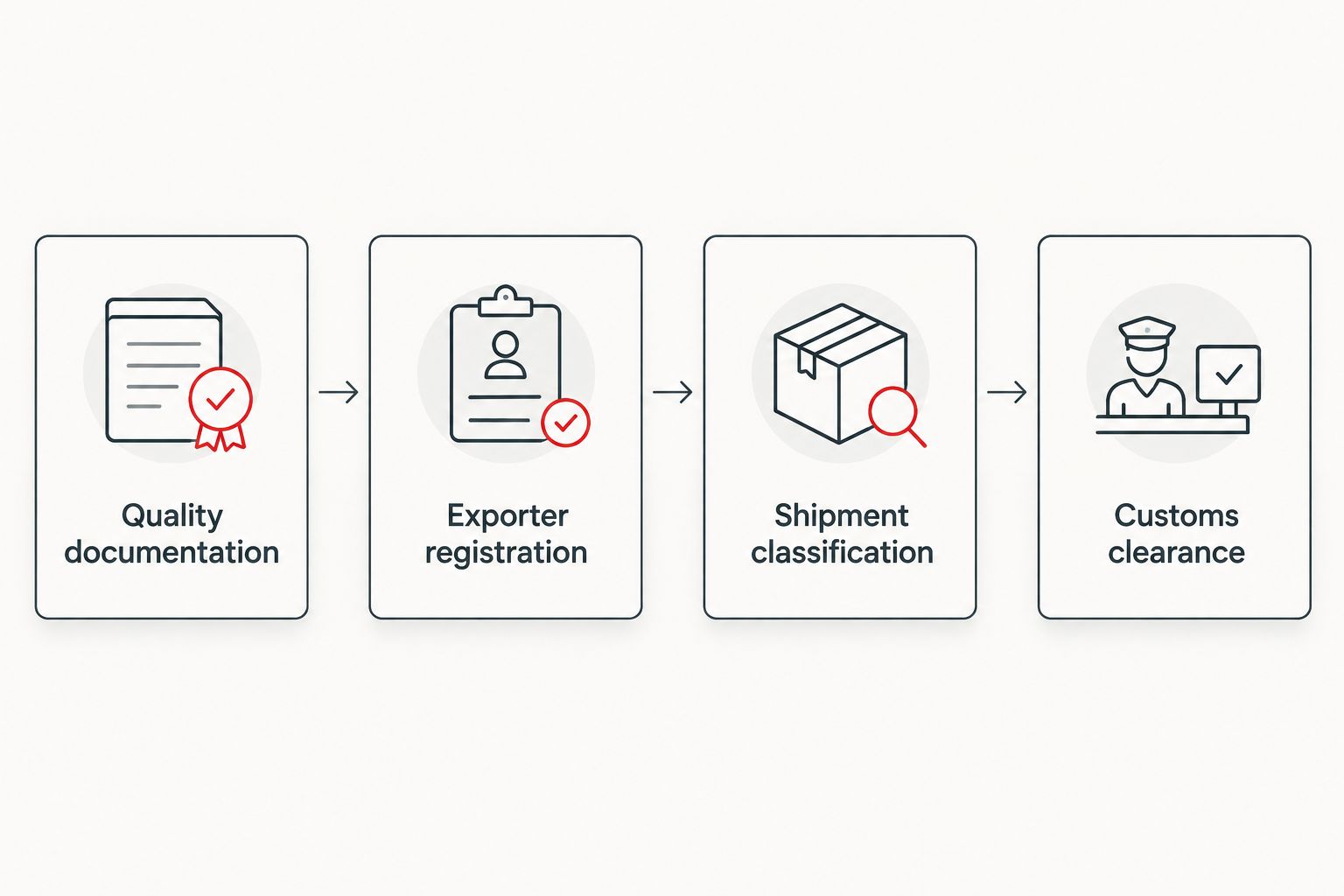
- A spice export documentation workflow runs four stages: sourcing and quality proof, exporter registration, shipment classification, and customs/phytosanitary clearance.
- An IEC code, an RCMC from the Spices Board of India, and a valid FSSAI license are non-negotiable before you book a container in 2026.
- Cardamom sits under HS code 0908, pepper under 0904, turmeric under 0910 — a mismatched code across invoice and packing list stalls customs.
- India's NPOP organic certificate needs a separate equivalency check for US or EU buyers; it doesn't travel automatically.
- Domestic bulk orders for cafés and hotels skip export paperwork entirely — a GST invoice and FSSAI compliance cover it.
Why this matters
Kerala grows most of India's green cardamom and a large share of its black pepper, much of it from GI-tagged regions like Idukki, Wayanad and Alleppey. A shipment that clears sourcing but fails on paperwork doesn't lose the product — it loses the sailing window, and spice quality drops with every extra week in transit humidity.
Most documentation failures in 2026 aren't exotic. They're a wrong HS code on one of three documents, an expired IEC confirmation, or an organic certificate the destination country doesn't recognize on its own. None of these show up until the shipment is already at the port. Muzri works with single-origin Kerala cardamom, pepper and turmeric where grade, farm origin and organic status are documented at the sourcing stage — which is exactly where this workflow starts.
Before you start
- A registered exporting entity — proprietorship, partnership or company, with a current GST registration, before you touch DGFT or Spices Board paperwork.
- Lot-level quality records from your supplier — certificate of analysis (COA), grade specification, and farm or estate origin, not a generic "Kerala cardamom" invoice line.
- The gotcha: pesticide residue testing at an accredited lab takes real time, and most first-time exporters book the phytosanitary inspection and the residue test on the same week as the shipment date. If the residue report comes back after the vessel is booked, the shipping window closes anyway — test the lot at the sourcing stage, not the shipping stage.
Set up your sourcing and quality documentation
- Get a certificate of analysis (COA) for each lot — moisture content, volatile oil, and pesticide residue results, tied to a specific farm or estate, not a blended batch.
- Confirm the grade on paper: 8 mm+ bold green cardamom or the applicable Spices Board grade code for pepper, matched line for line to what's on the eventual invoice.
- If the lot sits inside a GI-tagged zone — Idukki or Wayanad for cardamom, Wayanad or Idukki for Malabar pepper — keep the farm purchase record tied to that region. A GI claim without a traceable purchase record gets challenged by the buyer, not by Indian customs, and by then it's too late to fix.
- If organic status is part of the claim, attach the NPOP certificate and check separately whether the destination market needs its own equivalency letter — see why Idukki green cardamom costs more for how origin and grade drive the price a buyer is willing to pay for documented quality.
Expected result: a lot file with COA, grade sheet, and GI/organic proof attached, sitting ready before any export application starts.
Register as an exporter
- Apply for an Importer Exporter Code (IEC) — a 10-digit code issued by the DGFT — through the DGFT portal. No export shipment leaves India without one, spice or otherwise.
- Register with the Spices Board of India for a Registration-cum-Membership Certificate (RCMC). Spices are one of the few commodities with a dedicated commodity board rather than routing through APEDA.
- Hold a valid FSSAI license under the manufacturer/exporter category — a retail-only license doesn't cover export shipments.
- Confirm your IEC online each financial year on the DGFT portal. DGFT requires annual electronic confirmation even when nothing has changed; skip it and the code goes inactive mid-shipment.
Expected result: an active IEC number, RCMC number and FSSAI license number on file before any purchase order goes out to a buyer abroad.
Classify and package the shipment
- Assign the correct HS code on the commercial invoice: 0908 for cardamom, 0904 for pepper, 0910 for turmeric. One wrong digit here is the single most common customs hold for first-time spice exporters.
- Match the HS code, lot number and quantity across the commercial invoice, packing list and Certificate of Origin — three documents, one number set. Customs officers cross-check these against each other before they check the goods.
- Label each bag or carton with net weight, lot number and country of origin, matching the packing list line for line.
Expected result: invoice, packing list and Certificate of Origin that reference each other cleanly, with zero mismatched line items.
Clear phytosanitary and customs checkpoints
- Book a phytosanitary inspection with the Plant Quarantine department well before the shipment date. The resulting certificate confirms the consignment is free of regulated pests and is asked for by most importing countries for plant-derived spice.
- Run pesticide residue testing at an accredited lab and hold the report against the destination market's maximum residue limits (MRLs), which differ by country and sometimes by spice.
- File the shipping bill through ICEGATE once the phytosanitary certificate, COA and Certificate of Origin are all in hand.
Expected result: shipping bill accepted, phytosanitary certificate attached, container cleared for loading.
“If the residue test comes back after the vessel is already booked, the shipping window closes anyway — the fix is testing at the sourcing stage, not the shipping stage.”
Domestic bulk supply: a shorter version of the same workflow
A café chain or hotel group buying cardamom, pepper or turmeric in bulk within India doesn't touch IEC, RCMC or phytosanitary certificates at all. The workflow shrinks to two checks: an FSSAI-compliant invoice from the supplier, and the same lot-level COA and grade documentation used for export — because a hotel kitchen cares about grade and freshness just as much as a customs officer cares about pest-free certification. The green cardamom sourcing guide for hotels covers what a bulk buyer should ask a supplier for before placing a recurring order.
Troubleshooting
- Phytosanitary certificate delayed or rejected: usually a pest finding at inspection. Source from a single-origin lot with a recent COA rather than a mixed batch, and schedule inspection with buffer time before the shipping date.
- Shipment held over an HS code mismatch: check that 0908, 0904 or 0910 appears identically on the invoice, packing list and Certificate of Origin — a typo on one document is enough to trigger a hold.
- Organic certificate not accepted at destination: India's NPOP scheme has equivalency arrangements with some markets but not all. Confirm equivalency with the buyer's customs broker before the container ships, not after.
- IEC shows inactive at filing: the code wasn't confirmed on the DGFT portal for the current financial year. Reconfirm it online; it's a same-day fix if caught early.
- GI claim challenged by buyer: keep the farm purchase record on file, tied to the specific region — Idukki, Wayanad or Alleppey — not just a general "Kerala origin" statement on the invoice.
What to do next
Once the workflow runs cleanly for one shipment, the bottleneck moves from paperwork to sourcing consistency — the same grade, the same origin, lot after lot. That's a supplier question, not a customs question. Reading up on how cardamom grades are actually defined helps when a lot's grade sheet doesn't match what the buyer expected on arrival.
Source graded, traceable Kerala spice
Check grade, origin and organic details before you build the paperwork around a lot.
FAQ
What documents does a spice export shipment from India need in 2026?
An IEC code, RCMC from the Spices Board of India, a valid FSSAI license, a phytosanitary certificate, a certificate of analysis, a Certificate of Origin, a commercial invoice and a packing list. Missing any one of these is the usual cause of a customs hold.
Is APEDA registration required for spice exports?
No. Spices route through the Spices Board of India for RCMC registration instead of APEDA, since spices have their own dedicated commodity board under the Ministry of Commerce.
What HS code applies to cardamom, pepper and turmeric?
Cardamom falls under HS code 0908, pepper under 0904, and turmeric under 0910, all within chapter 9 of the HS classification for spices.
Does an organic certificate automatically apply for export markets?
Not automatically. India's NPOP organic certification needs a separate equivalency check for markets like the US or EU before a buyer will accept it as proof of organic status.
What's the difference between export documentation and domestic bulk supply paperwork?
Export needs IEC, RCMC, phytosanitary clearance and customs filing. Domestic bulk supply to a café or hotel only needs an FSSAI-compliant invoice and the supplier's grade and quality documentation.
How long is an IEC code valid?
The code itself doesn't expire, but DGFT requires it to be confirmed online every financial year even when nothing has changed. Skipping that confirmation makes the code inactive for filing.
Why do GI tags matter for spice export documentation?
A GI tag like Idukki or Alleppey for cardamom proves region-specific origin, which matters for premium buyer claims and for defending traceability if a buyer questions the lot's source.
Can cardamom, pepper and turmeric ship together in one consignment?
Yes, as long as each product carries its own correct HS code, COA and grade documentation on the invoice and packing list.
One last thing
The paperwork rarely fails on the exotic requirement — it fails on the residue test scheduled too late to matter. Booking that test the same week a lot is confirmed, rather than the week a container is booked, removes the single most common delay in this whole workflow in 2026.